Methylene blue: effects, history and what research shows
Peptidkauf Redaktion4 min read
Methylene blue is one of the most unusual substances in the lab: textile dye, first synthetic drug, standard stain in microscopy and now a tool of mitochondrial research. On social media it is promoted as a "biohacking" agent, often without mention of its well-documented risks. This article explains what methylene blue is chemically, how its effects in the cell arise, what studies show and where the limits are. It describes research and contains no usage or dosing advice.
At a glance
- Methylene blue (methylthioninium chloride) is a dye that switches between a blue and a colourless form and transfers electrons in the process.
- In the EU it is approved as a medicine for methaemoglobinaemia; all other uses are research.
- In cell and animal models it can route electrons around blocked sites of the respiratory chain.
- Methylene blue inhibits the enzyme MAO-A and can trigger serotonin syndrome together with serotonergic drugs.
What is methylene blue?
Methylene blue is a small, positively charged molecule with the formula C₁₆H₁₈ClN₃S, not a peptide. Heinrich Caro synthesised it at BASF in 1876 as a dye for cotton. A few years later Paul Ehrlich used it to stain nerve tissue and bacteria, and in 1891 he used it as the first fully synthetic antimalarial. Methylene blue thus stands at the start of modern chemotherapy.
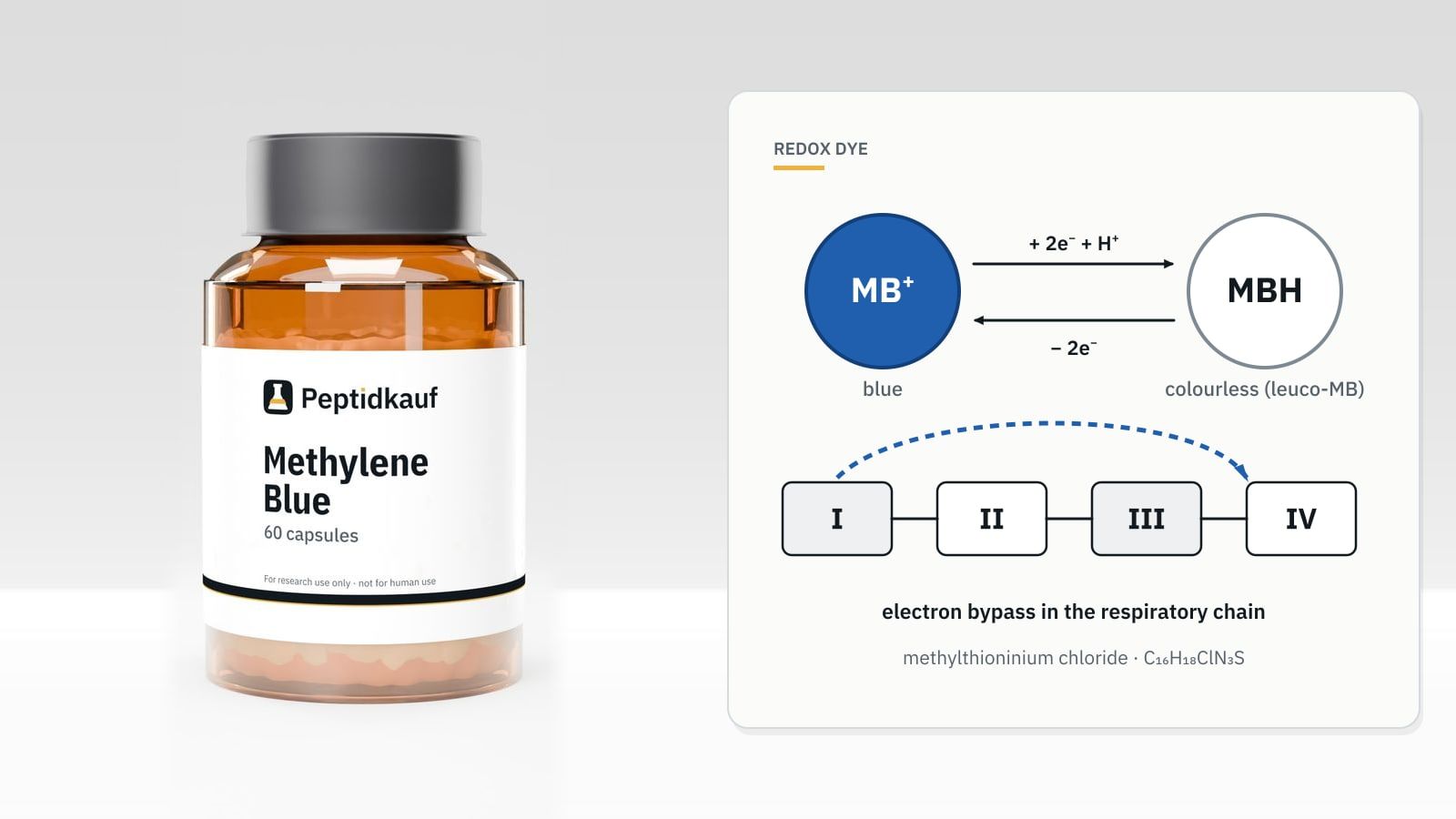
The key chemistry is the redox switch: methylene blue (MB⁺) takes up two electrons and a proton and becomes colourless leucomethylene blue (MBH). The colourless form readily gives the electrons away again and turns blue. This cycle also runs inside cells and underlies almost all of its biological effects.
How does methylene blue act in the cell?
An electron bypass in the respiratory chain
In mitochondria, electrons travel through four complexes (I to IV) to oxygen, generating the energy for ATP. At low concentrations methylene blue can accept electrons from NADH and pass them directly to cytochrome c, bypassing complexes I and III. In cell models where these complexes are inhibited, methylene blue kept oxygen consumption going. This is the basis of interest from neurodegeneration and ageing research.
Concentration decides
The effect depends strongly on concentration. Low concentrations acted as antioxidants in models, higher ones as pro-oxidants, because methylene blue then generates reactive oxygen species itself. This inverted U-shaped curve makes laboratory results hard to translate and explains contradictory findings.
Inhibition of monoamine oxidase A
Methylene blue is a potent inhibitor of monoamine oxidase A (MAO-A), which breaks down serotonin and noradrenaline. For research this is a confounder; for safety it is a central point (see below).
Tau aggregation
In cell experiments methylene blue prevented the protein tau from assembling into fibres, as happens in Alzheimer's disease. A stabilised variant (hydromethylthionine) was therefore tested in large phase 3 trials. The primary endpoints were not met; the analysis of subgroups is disputed.
What do the studies show?
| Area | Evidence | Status |
|---|---|---|
| Methaemoglobinaemia | Clinical practice for decades | Approved |
| Mitochondria, neuroprotection | Cell and animal models | Preclinical |
| Alzheimer's (tau) | Phase 3 trials with a stabilised variant | Primary endpoints missed |
| Memory in humans | Small imaging studies | Preliminary |
| Microscopy, staining | Laboratory standard | Established |
A few small functional imaging studies described altered brain activity during memory tasks after a single administration. Such findings are interesting but too small and too short to infer a benefit.
Risks and side effects
- Serotonin syndrome: together with SSRI or SNRI antidepressants and other serotonergic drugs, methylene blue can trigger life-threatening serotonin syndrome. Medicines regulators have issued explicit warnings.
- G6PD deficiency: in people with glucose-6-phosphate dehydrogenase deficiency, methylene blue can destroy red blood cells.
- High concentrations: paradoxically, they can themselves cause methaemoglobin formation.
- Harmless but striking: blue to green discolouration of urine and mucous membranes.
Methylene blue in the lab
In the lab methylene blue serves as a stain (for example for bacteria and cell nuclei), as a redox indicator and as a tool for studying electron transport in isolated mitochondria. Solutions are light-sensitive and should be stored in the dark. Purity matters for experiments: technical grades can contain heavy metals and synthesis by-products. Peptidkauf offers methylene blue capsules as a research reagent with a lab report for every batch; related approaches in mitochondrial research are NAD+ and SS-31.
Frequently asked questions about methylene blue
What is methylene blue?
A synthetic dye (methylthioninium chloride) that can transfer electrons. It is approved as a medicine for methaemoglobinaemia and is a standard laboratory reagent.
How does methylene blue affect mitochondria?
In models it takes electrons from NADH and passes them to cytochrome c, so it can bypass blocked sections of the respiratory chain.
Is methylene blue dangerous?
It has known risks: with serotonergic drugs it can trigger serotonin syndrome, in G6PD deficiency it can damage red blood cells, and at high concentrations it acts as a pro-oxidant.
Does methylene blue help in Alzheimer's disease?
A stabilised variant was tested in large trials and missed its primary endpoints. A benefit has not been shown.
Is methylene blue a peptide?
No. It is a small organic molecule, but it is often considered alongside peptides such as SS-31 or MOTS-c in mitochondrial research.
Conclusion
Methylene blue is no miracle cure but a remarkably versatile molecule with a long history. Its redox property makes it a genuine tool of mitochondrial research; clinical evidence outside methaemoglobinaemia is thin. Anyone working with it should know its concentration dependence and MAO-A inhibition and insist on tested purity.