AICAR and AOD-9604: what the research on fat metabolism shows
Peptidkauf RedaktionUpdated: 5 min read
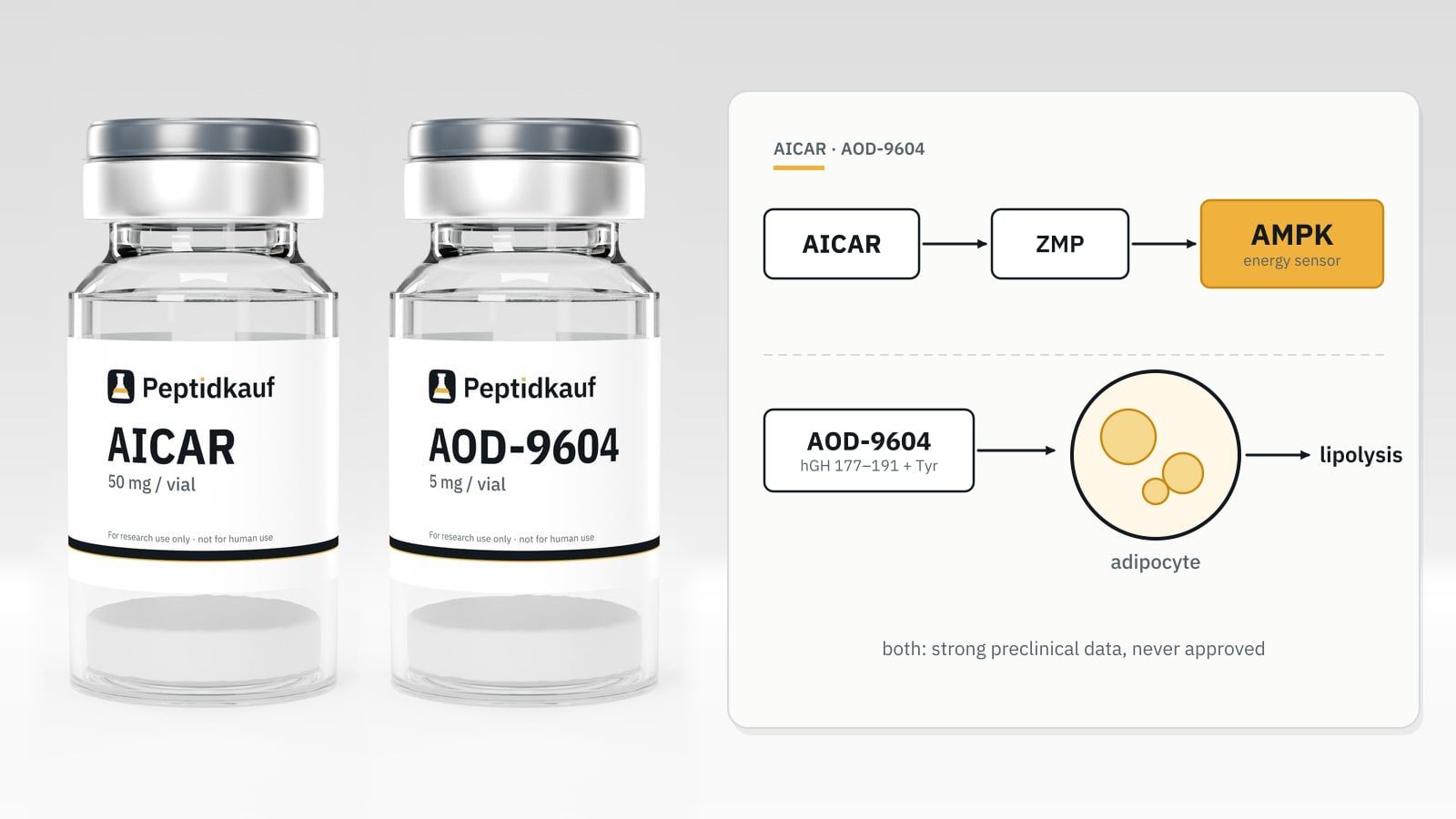
AICAR and AOD-9604 are often mentioned together, usually in connection with fat metabolism. Chemically and biologically they have almost nothing in common: one is a small nucleoside analogue that activates a cellular energy sensor, the other a fragment of human growth hormone. This article explains both, what studies in cells, animals and humans actually reported, and why the step from a lab finding to a claim about people is so large. It describes research only and contains no instructions for use and no dosages.
Key points
- AICAR is a precursor of an AMP mimic that activates the enzyme AMPK; it is not a peptide.
- AOD-9604 is a synthetic fragment from the end of human growth hormone, studied for effects on fat tissue.
- The best-known AICAR findings come from mice; AOD-9604 reached human trials but did not show a clear benefit over placebo.
- Both are on the World Anti-Doping Agency's prohibited list and neither is an approved medicine in the EU.
Two different molecules
| Property | AICAR | AOD-9604 |
|---|---|---|
| Chemical class | Nucleoside analogue (not a peptide) | Peptide, 16 amino acids |
| Origin | Intermediate of purine metabolism | Fragment 177–191 of human growth hormone plus an added tyrosine |
| Main target studied | AMPK, the cellular energy sensor | Fat cells, lipolysis and fat storage |
| Human data | Studied clinically under the name acadesine for other indications | Phase 2 trials on weight; no clear benefit |
AICAR and the energy sensor AMPK
AICAR, short for 5-aminoimidazole-4-carboxamide ribonucleoside, enters cells and is converted to ZMP, a molecule that resembles AMP. AMP rises when a cell is short of energy, and it switches on AMP-activated protein kinase, AMPK. Activated AMPK shifts metabolism towards energy production: more glucose uptake, more fatty-acid oxidation, less energy-consuming synthesis. That makes AICAR a standard tool in cell biology for asking what happens when AMPK is switched on.
The "exercise mimetic" study
AICAR became widely known through a 2008 study in mice. Sedentary mice treated with AICAR ran further on a treadmill and showed changes in muscle gene expression that resembled those after endurance training. The press called it an "exercise pill".
The study is important, but its limits are clear: it was done in mice, the effect depended on the model, and ZMP affects more enzymes than AMPK alone. Later work showed that some AICAR effects occur even without AMPK, so results with AICAR cannot automatically be read as AMPK effects.
In humans
Under the name acadesine, the substance was studied clinically decades ago for protection of heart muscle during surgery and later for certain blood cancers. Those programmes were about other questions and did not lead to an approval. Robust studies on fat metabolism or endurance in healthy people do not exist.
AOD-9604 and growth hormone
Human growth hormone has 191 amino acids. Research in the 1990s suggested that the region at its end, around positions 177 to 191, is associated with effects on fat tissue without the growth-promoting effects of the whole hormone. AOD-9604 is a synthetic version of this fragment with an extra tyrosine at the start, developed by an Australian company as a possible anti-obesity drug.
What the studies showed
In cell and animal studies, the fragment was reported to stimulate the breakdown of stored fat (lipolysis) and inhibit its formation in fat cells, and obese rodents lost weight. Unlike growth hormone itself, it did not appear to raise IGF-1 or affect blood sugar in these models.
AOD-9604 then went into human trials. Early studies were reported as well tolerated, but a larger phase 2b trial in overweight participants did not show a significant difference in weight loss compared with placebo, and development as an obesity drug was stopped. That is the decisive point: the hypothesis was tested in people and was not confirmed.
Why lab results do not transfer automatically
Both substances show a familiar pattern. A clear mechanism in cells and an effect in rodents make a substance interesting, but people differ in metabolism, dosing kinetics, body composition and lifestyle. Many metabolic compounds that worked in mice did not work in humans, and AOD-9604 is one documented example.
When reading claims about either substance, ask three questions. Was it measured in cells, animals or people? Which outcome was measured: a marker in a dish, body weight, performance? And has anyone repeated it independently?
Regulatory status
Neither AICAR nor AOD-9604 is approved as a medicine in the EU. Both are on the World Anti-Doping Agency's prohibited list: AICAR as a metabolic modulator (AMPK activator), AOD-9604 among growth hormone fragments. As research reagents they are intended for laboratory experiments, not for humans.
What this means for lab work
- AICAR is not a peptide. It is a small molecule; it dissolves differently from peptides and is quantified by its own analytical methods. Treat stock solutions accordingly.
- Controls for AMPK experiments. Because AICAR acts beyond AMPK, specific approaches such as AMPK-deficient cells or a second activator help separate effects.
- Identity of AOD-9604. The fragment is close in sequence to other growth hormone fragments sold under similar names; mass spectrometry confirms which one is in the vial. See peptide purity: reading HPLC, MS and the COA.
- Document everything. Batch number, storage and dissolution date make unexpected results explainable later.
Frequently asked questions
Are AICAR and AOD-9604 similar?
No. AICAR is a nucleoside analogue that activates AMPK; AOD-9604 is a peptide fragment of growth hormone. They are only grouped together because both are associated with fat metabolism.
Is AICAR an "exercise pill"?
That label comes from a mouse study. There is no robust evidence that it replaces exercise in humans.
Did AOD-9604 work in human trials?
Early trials reported good tolerability, but a larger trial did not show a significant weight-loss benefit over placebo, and development as an obesity drug ended.
Are they approved?
No. Neither is an approved medicine in the EU, and both are on the WADA prohibited list.
Conclusion
AICAR and AOD-9604 illustrate two sides of metabolic research. AICAR remains a valuable lab tool for studying the energy sensor AMPK, with the caveat that it acts on more than one target. AOD-9604 is a fragment whose hypothesis was tested in people and not confirmed. For both, findings in cells and mice are a reason for further research, not a statement about the human body.
For laboratory work, AICAR and AOD-9604 are available as research reagents with a batch-specific lab report.