Peptide purity: reading a lab report line by line
Peptidkauf Redaktion3 min read
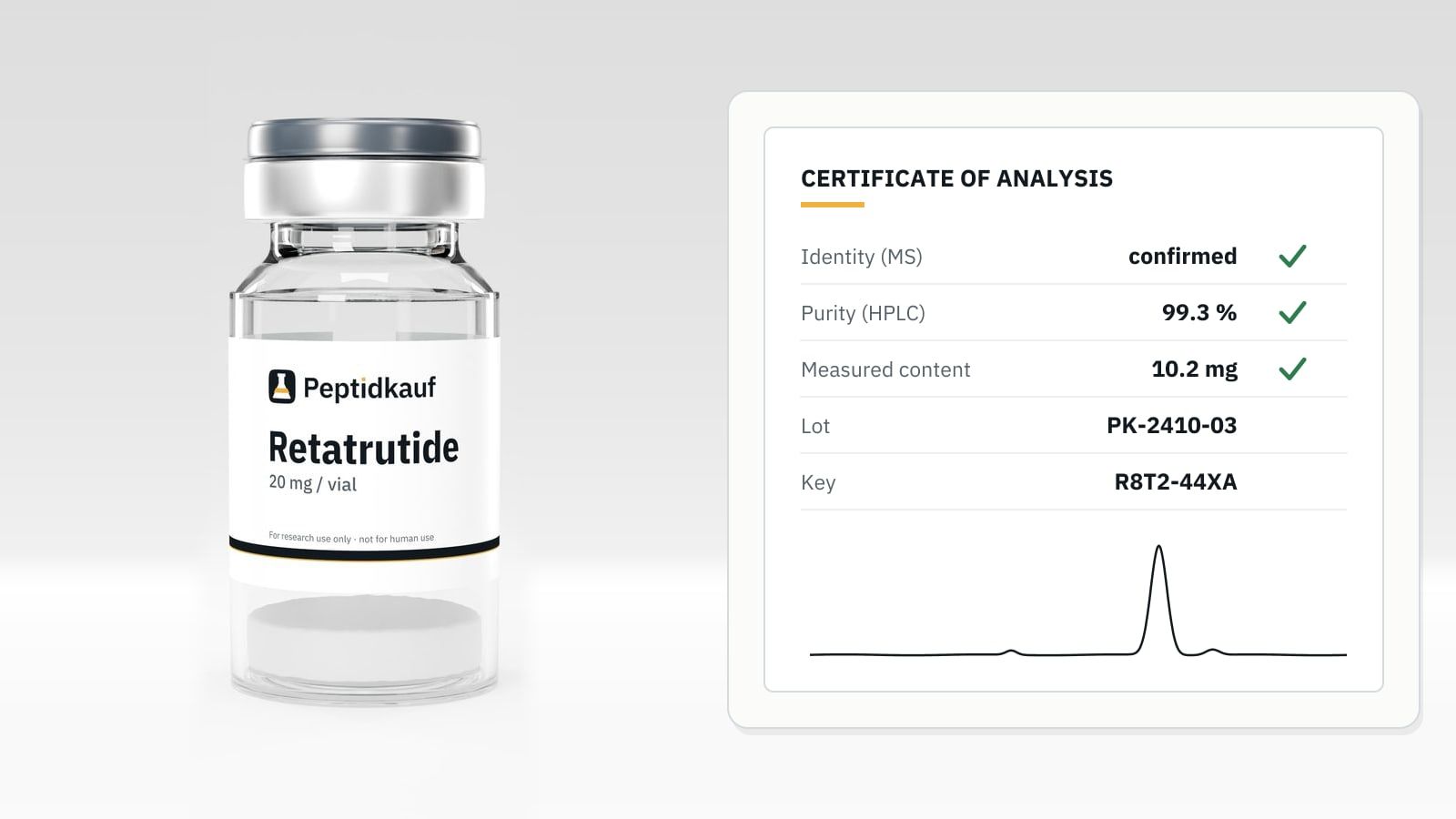
'≥99 % purity' appears on almost every peptide page online. What that number means, and what it hides, only the lab report behind it shows. This article walks through a report as Peptidkauf publishes one for every batch: field by field, with what it says and what to watch for, and ends with a checklist for checking any report in minutes.
At a glance
- HPLC purity says how clean a sample is chromatographically, not which molecule it is.
- The measured amount shows how much peptide is actually in the vial, often more important than purity.
- A report applies only to the batch whose number it carries.
- A verification key lets you check the report directly at the laboratory.
A lab report, field by field
| Field | What it tells you | What to check |
|---|---|---|
| Laboratory and order number | Who measured | An independent lab, not the manufacturer |
| Sample / batch number | Which batch was measured | Must match the number on the vial |
| Analysis date | When it was measured | Should fit the batch, not be years older |
| Purity (HPLC) | Share of the main signal in the chromatogram | Method matters; the number alone does not prove identity |
| Measured amount | How much peptide is in the vial | Compare with the label |
| Identity | Whether the expected molecule was detected | Crucial for substances often confused |
| Verification key | Code to check the report at the lab | Allows comparison with the lab's database |
Purity: what HPLC measures
The sample is pumped through a separation column; different substances take different times to emerge and a detector records the signal as peaks. Purity is the main peak's share of the total peak area. It depends on the method, since a coarse separation can hide impurities under the main peak, and it does not say which molecule the main peak is. See how to read a chromatogram.
Measured amount: the underrated number
A vial labelled '10 mg' can contain noticeably less peptide, because of counter-ions and residual water or simply under-filling. A solution calculated from the label is then too weak. That is why Peptidkauf shows the measured amount for every batch on the product page, and you can use it in the peptide calculator.
Identity: the right molecule
Identity is usually confirmed by mass spectrometry. Two examples from our range: retatrutide is blind-tested against semaglutide and tirzepatide, and for TB-500 the report distinguishes complete thymosin beta-4 from the short fragment (more).
Batch number and verification key
Every batch carries its own number, printed on each vial, and a report applies only to that number. The verification key lets you retrieve the report from the laboratory and compare it with the published PDF. All reports are in the lab report archive; traceability is explained in batches and traceability.
Checklist
- Does the batch number match the vial?
- Did an independent laboratory measure, and can the report be verified there?
- Does the analysis date fit the batch?
- How does the measured amount compare with the label?
- Was identity shown, not only purity?
Warning signs
- One certificate for all batches, or no batch reference at all
- No way to verify the report at the laboratory
- Only a purity figure, no amount and no identity
- Identical values and dates for different products
Conclusion
A good lab report answers three questions: is it the right molecule, how clean is it and how much is in the vial? Purity alone answers only the second.