Semax and selank: effects, studies and what is actually proven
Peptidkauf Redaktion4 min read
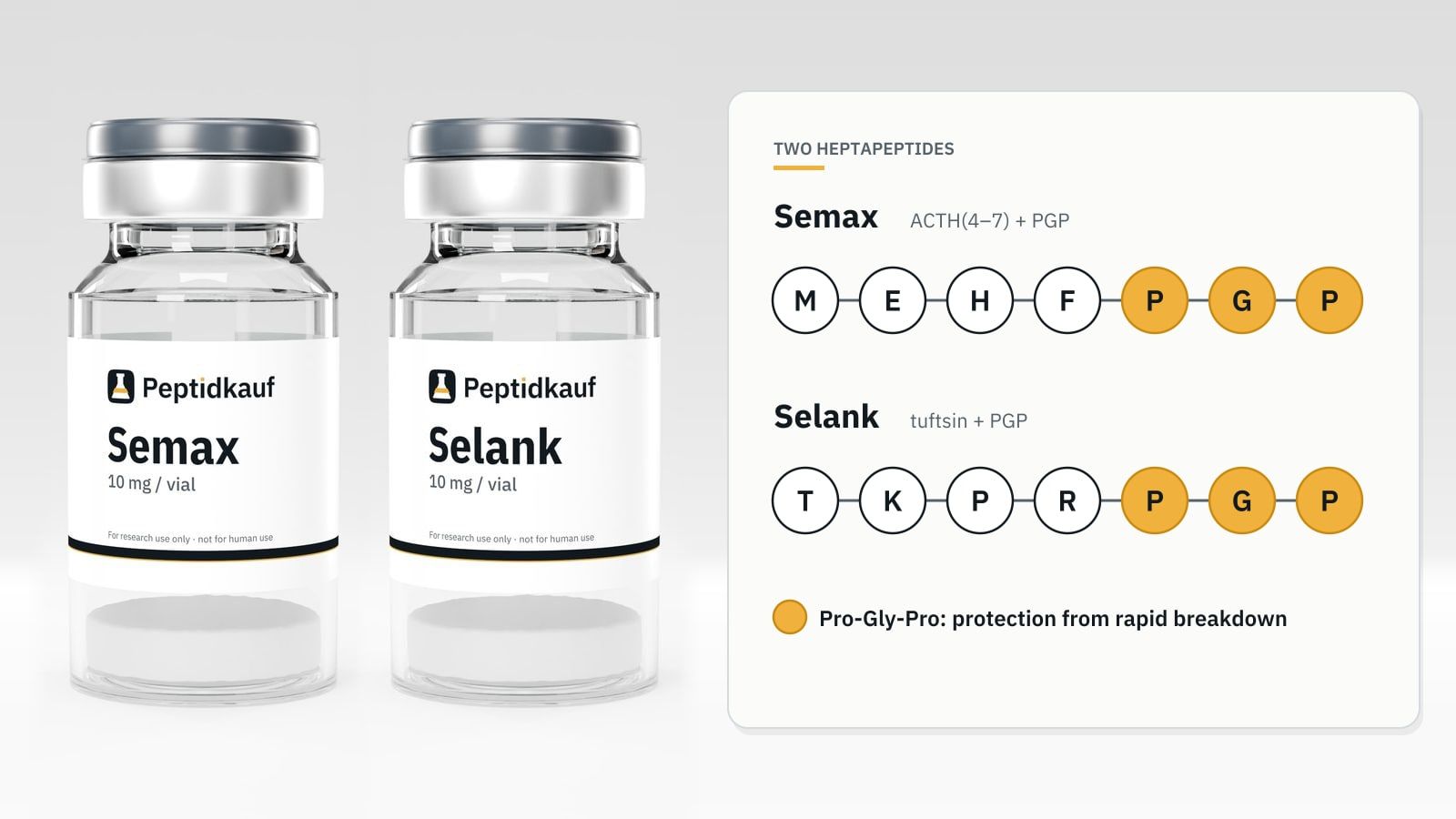
Semax and selank are among the most searched neuropeptides. Both come from the same Moscow institute, both are approved in Russia as nasal products, and both are marketed internationally as "nootropics". The evidence is unusual, though: many papers, almost all from Russia, and hardly any independent controlled studies. This article explains how the two peptides are built, what research describes about their effects and how to weigh the evidence. It describes research and contains no usage or dosing advice.
At a glance
- Semax (MEHFPGP) derives from the ACTH fragment 4–7, selank (TKPRPGP) from the immune peptide tuftsin.
- Both end in the sequence Pro-Gly-Pro, which protects them from rapid breakdown.
- For semax, raised BDNF levels in animal models are the main finding; for selank, effects on the GABA system and cytokines.
- Both are approved only in Russia, not in the EU or the US.
Origin: one institute, one design principle
Semax and selank were created at the Institute of Molecular Genetics of the Russian Academy of Sciences, selank in collaboration with the Zakusov Institute of Pharmacology. The principle is the same for both: a short, naturally occurring peptide with a known effect is extended by the three amino acids Pro-Gly-Pro. This ending makes the molecule more resistant to peptidases that degrade chains from the end.
| Feature | Semax | Selank |
|---|---|---|
| Sequence | Met-Glu-His-Phe-Pro-Gly-Pro | Thr-Lys-Pro-Arg-Pro-Gly-Pro |
| Parent peptide | ACTH(4–7) | Tuftsin |
| Hormonal ACTH activity | None | None |
| Research focus | BDNF, neuroprotection | Anxiety, stress, immune system |
| Approval | Russia (nasal drops) | Russia (nasal drops) |
A detailed comparison is in semax vs. selank.
Semax: what research shows
ACTH(4–10) and shorter fragments attracted attention in the 1970s because they influenced learning behaviour in animal experiments without stimulating the adrenal gland. Semax was developed from them as a more stable variant.
- BDNF: in rats, semax raised levels of the nerve growth factor BDNF and its receptor TrkB in the hippocampus. This is the most frequently cited finding.
- Ischaemia models: in animal models of stroke, papers described smaller damage and altered expression of inflammatory and vascular genes.
- Clinical data: Russian studies in stroke and cognitive disorders are mostly small, open-label or poorly documented. Large, independent, placebo-controlled trials are lacking.
Selank: what research shows
Tuftsin is a tetrapeptide from an antibody fragment that activates phagocytes. Selank extends it and was developed as an anxiolytic without the typical side effects of benzodiazepines.
- GABA system: papers describe modulation of GABA-A receptors and altered expression of GABA signalling genes.
- Enkephalins: in models selank inhibits enzymes that break down the body's own enkephalins.
- Immune system: like tuftsin, selank changes the production of cytokines such as IL-6.
- Clinical data: small Russian studies in anxiety disorders reported effects described as comparable to a benzodiazepine. Independent confirmation is lacking here too.
How robust are the data?
The literature on semax and selank is extensive but one-sided. Three points matter:
- Almost all studies come from a few Russian groups, often involving the developers.
- Many papers are published only in Russian and are hard to check.
- Most evidence comes from animal models; clinical studies are small and methodologically weak.
This does not mean the peptides are inactive, but that their effects in humans are not established by international standards.
Stabilised variants
Besides the originals there are forms with capped ends: N-acetyl semax amidate and N-acetyl selank amidate. The acetyl group and amide are meant to slow breakdown further. Dedicated studies on these variants are rare, which makes them interesting for comparative laboratory experiments. Another semax variant is Adamax.
Semax and selank in the lab
For cell and animal models both are used as lyophilised powder. Identity testing matters because the masses of the original and acetylated forms differ only slightly. Peptidkauf offers semax, selank and the combination semax + selank as research reagents with a lab report for every batch.
Frequently asked questions
What is semax?
A synthetic heptapeptide from the ACTH fragment 4–7 with an added Pro-Gly-Pro. It is studied mainly for BDNF and neuroprotection.
What is selank?
A synthetic heptapeptide derived from the immune peptide tuftsin, studied in models of anxiety, stress and immune signalling.
Are semax and selank approved in the EU?
No. Both are approved as medicines only in Russia.
What is the difference between semax and N-acetyl semax?
N-acetyl semax amidate has the same sequence but capped ends intended to slow breakdown. Comparative studies hardly exist.
Conclusion
Semax and selank are elegantly designed peptides with interesting findings in animal models, especially on BDNF and the GABA system. Their effects in humans, however, are not established by international standards. For research they remain intriguing tools whose results need independent confirmation.