Retatrutide: mechanism of action, trials and approval status
Peptidkauf Redaktion6 min read
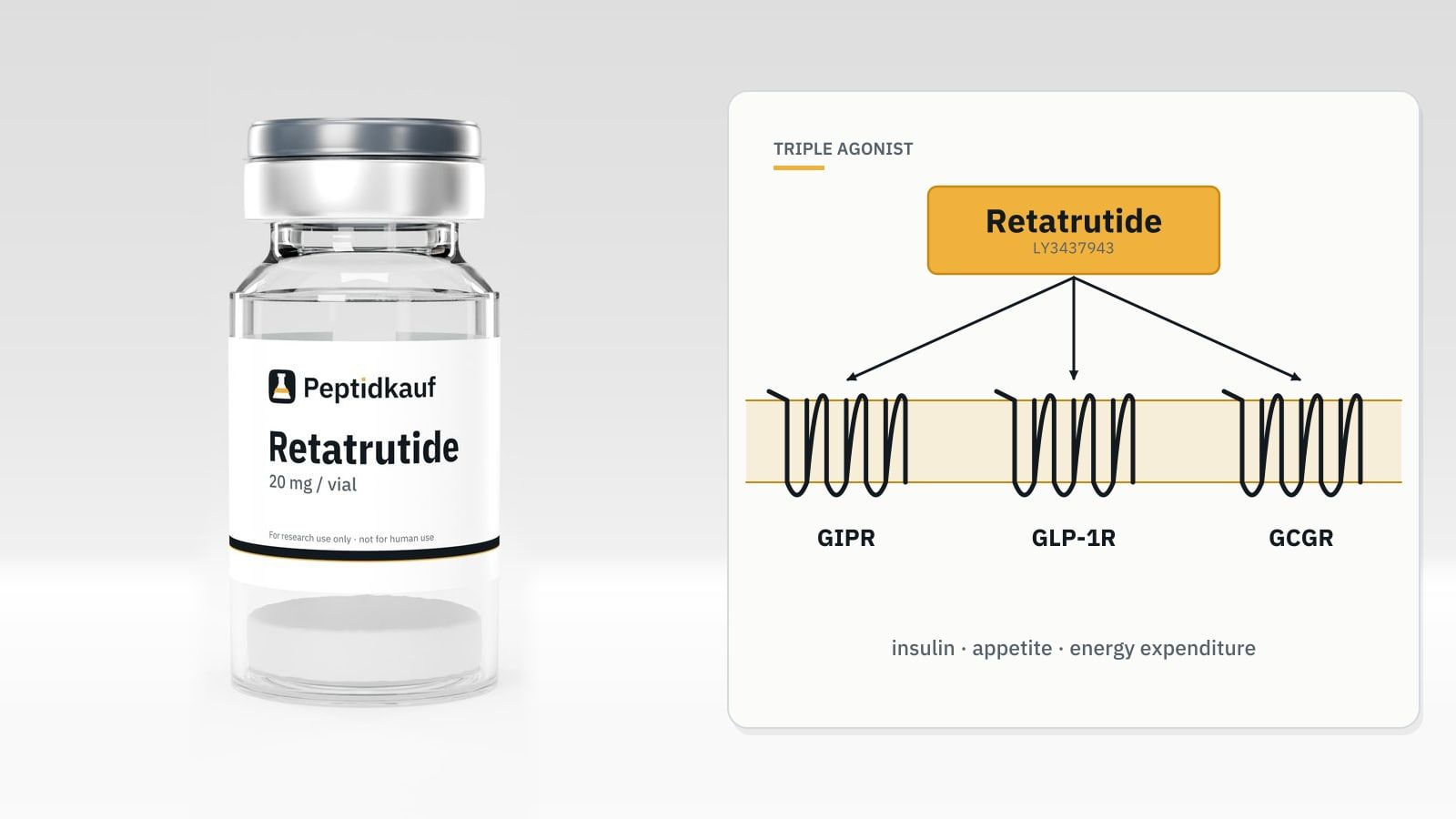
Retatrutide is the best-known peptide of the new generation of metabolic drugs. Semaglutide acts on one hormone receptor and tirzepatide on two; retatrutide activates three: the receptors for GIP, GLP-1 and glucagon. In a phase 2 trial body weight fell further than with any compound before it. Even so, retatrutide is not approved anywhere. This article explains how the compound works, what the trials actually showed, which side effects occurred and what the names retatrutide, Triple G and GLP-3 mean. It describes research and contains no usage or dosing advice.
At a glance
- Retatrutide (code LY3437943) is a triple agonist at the GIP, GLP-1 and glucagon receptors, developed by Eli Lilly.
- In the 2023 phase 2 trial, weight in the highest dose group fell by about 24 per cent on average after 48 weeks.
- The most common side effects were nausea, diarrhoea and vomiting; heart rate rose with dose.
- The phase 3 TRIUMPH programme is under way. There is no approval in the EU or the US.
What is retatrutide?
Retatrutide is a synthetic peptide developed by the US company Eli Lilly under the code LY3437943. The chain carries a fatty acid that binds the blood protein albumin. This slows breakdown and keeps the peptide in circulation for several days, which allowed once-weekly administration in the trials.
Retatrutide, Triple G, GLP-3: one compound, many names
"Retatrutide" is the international non-proprietary name (INN); "Retatrutid" is the German spelling. In the research peptide trade the compound is often called "Triple G", after the three receptors whose hormone names start with G (GIP, GLP-1, glucagon). "GLP-3", by contrast, is pure marketing: no hormone called GLP-3 exists. Studies are listed under retatrutide or LY3437943.
How does retatrutide work? Three receptors, three points of action
Retatrutide mimics three hormones the body makes itself to regulate energy metabolism.
| Receptor | Natural hormone | Role in models |
|---|---|---|
| GLP-1 receptor | GLP-1 from the gut | Increases insulin release after meals, slows gastric emptying, dampens appetite in the brain |
| GIP receptor | GIP from the gut | Amplifies insulin release, acts on adipose tissue; combined with GLP-1 it improves tolerability |
| Glucagon receptor | Glucagon from the pancreas | Raises energy expenditure and fat breakdown in the liver |
The glucagon component is the new part. Glucagon is considered insulin's counterpart because it raises blood glucose. Combined with GLP-1, however, other effects dominate in models: higher energy expenditure and less fat in the liver. Early laboratory work described retatrutide as especially potent at the GIP receptor and somewhat weaker than the natural hormones at the other two.
How it differs from semaglutide and tirzepatide
| Compound | Receptors | Status (2026) |
|---|---|---|
| Semaglutide | GLP-1 | Approved in the EU (diabetes, obesity) |
| Tirzepatide | GIP + GLP-1 | Approved in the EU (diabetes, obesity) |
| Retatrutide | GIP + GLP-1 + glucagon | Not approved, phase 3 |
A detailed side-by-side is in retatrutide vs. tirzepatide. The whole drug class is covered in GLP-1 agonists explained.
What do the trials show?
Phase 1: first human data
The first studies tested tolerability and pharmacokinetics in healthy volunteers and people with type 2 diabetes. They confirmed the long half-life and already showed dose-dependent weight loss.
Phase 2: the 2023 obesity trial
The best-known paper appeared in the New England Journal of Medicine in 2023. 338 adults with obesity, or overweight with a related condition but without diabetes, received retatrutide at several dose levels or placebo for 48 weeks.
- In the highest dose group, body weight fell by about 24 per cent on average, compared with about 2 per cent on placebo.
- In the higher dose groups the weight curve had not yet reached a plateau at 48 weeks.
- Blood pressure, blood lipids and glucose values also improved.
These numbers explain the attention: they exceeded the figures reported for semaglutide and tirzepatide in their registration trials. A direct comparison is not valid, though, because design, duration and participants differed.
Phase 2: type 2 diabetes and liver fat
A second phase 2 trial in people with type 2 diabetes reported marked reductions in long-term blood glucose (HbA1c) and weight. A sub-analysis in people with fatty liver found that liver fat normalised in most participants. That fits the glucagon component, which in models targets liver fat metabolism.
Phase 3: the TRIUMPH programme
Since 2023 the phase 3 TRIUMPH programme has been running several large trials, including obesity, type 2 diabetes, cardiovascular risk and knee osteoarthritis. The manufacturer reported first phase 3 results at the end of 2025. Until all trials are fully published and assessed by regulators, the evidence remains provisional.
Side effects in the trials
Side effects largely matched those of other GLP-1-based drugs.
- Gastrointestinal: nausea, diarrhoea, vomiting and constipation were most common, mostly mild to moderate and mainly during dose escalation.
- Heart rate: resting heart rate rose with dose, peaked after a few months and then partly declined.
- Discontinuations: in the higher dose groups more participants stopped because of side effects than on placebo.
Multi-year data are lacking. Rare side effects often only appear in large trials or after approval.
What is known from the drug class
For approved GLP-1-based drugs such as semaglutide and tirzepatide, rare but serious risks have been described, such as pancreatitis and gallstones, particularly with rapid weight loss. Whether and to what extent this applies to retatrutide is for the phase 3 trials to show. It is also open how the additional glucagon activity affects heart rate and metabolism in the long term. When judging side effects, separate observed trial data from assumptions based on the drug class.
Approval status
Retatrutide is not approved as a medicine in the EU or the US. Approval requires phase 3 trials that demonstrate efficacy and safety and a regulatory review of the data. Until then, outside clinical trials retatrutide is only available as a research reagent for laboratory experiments.
Retatrutide in the lab: identity is everything
GLP-1 analogues are frequently confused or mislabelled on the market, so identity testing is decisive for laboratory work. Mass spectrometry shows whether the molecule has the expected mass, and HPLC shows how pure it is. At Peptidkauf the independent laboratory tests every batch blind against semaglutide, tirzepatide and retatrutide; the report is viewable before purchase. How to read such a report is explained in peptide purity: HPLC, MS and the COA.
Common misconceptions
"GLP-3 is a new hormone." No. GLP-3 is a trade name; retatrutide acts at GIP, GLP-1 and glucagon receptors.
"Retatrutide has been proven stronger than tirzepatide." There are no head-to-head trials. The figures come from different trials with different designs.
"What works in trials is approved." Years and thousands of participants lie between a phase 2 trial and an approval.
"Triple G is something other than retatrutide." In the trade, Triple G usually means retatrutide. Only an analysis shows what is actually in the vial.
Frequently asked questions about retatrutide
What is retatrutide?
A synthetic peptide from Eli Lilly that activates the GIP, GLP-1 and glucagon receptors at the same time. It is being tested clinically for obesity and type 2 diabetes.
Is retatrutide approved?
No. Retatrutide is in phase 3 trials and is not approved as a medicine in the EU or the US.
What does Triple G mean?
A trade name for retatrutide, derived from its three receptors GIP, GLP-1 and glucagon.
How does retatrutide differ from tirzepatide?
Tirzepatide activates two receptors (GIP and GLP-1); retatrutide also activates the glucagon receptor. Tirzepatide is approved, retatrutide is not.
Which side effects were reported?
Mainly nausea, diarrhoea, vomiting and constipation, plus a dose-dependent rise in heart rate.
Where can retatrutide be obtained for laboratory work?
As a research reagent from suppliers that have the identity of every batch tested independently. Peptidkauf offers retatrutide with a lab report for every batch, for laboratory use only.
Conclusion
Retatrutide is the first triple agonist to reach large phase 3 trials, and its phase 2 results were striking. At the same time it is not approved, long-term data are missing, and many figures online compare trials that cannot be compared. For research, retatrutide is a valuable tool for studying how GIP, GLP-1 and glucagon interact. What matters is tested material and a sober reading of the trials.