Reconstitution in vitro: solvents, concentration, aliquots
Peptidkauf Redaktion2 min read
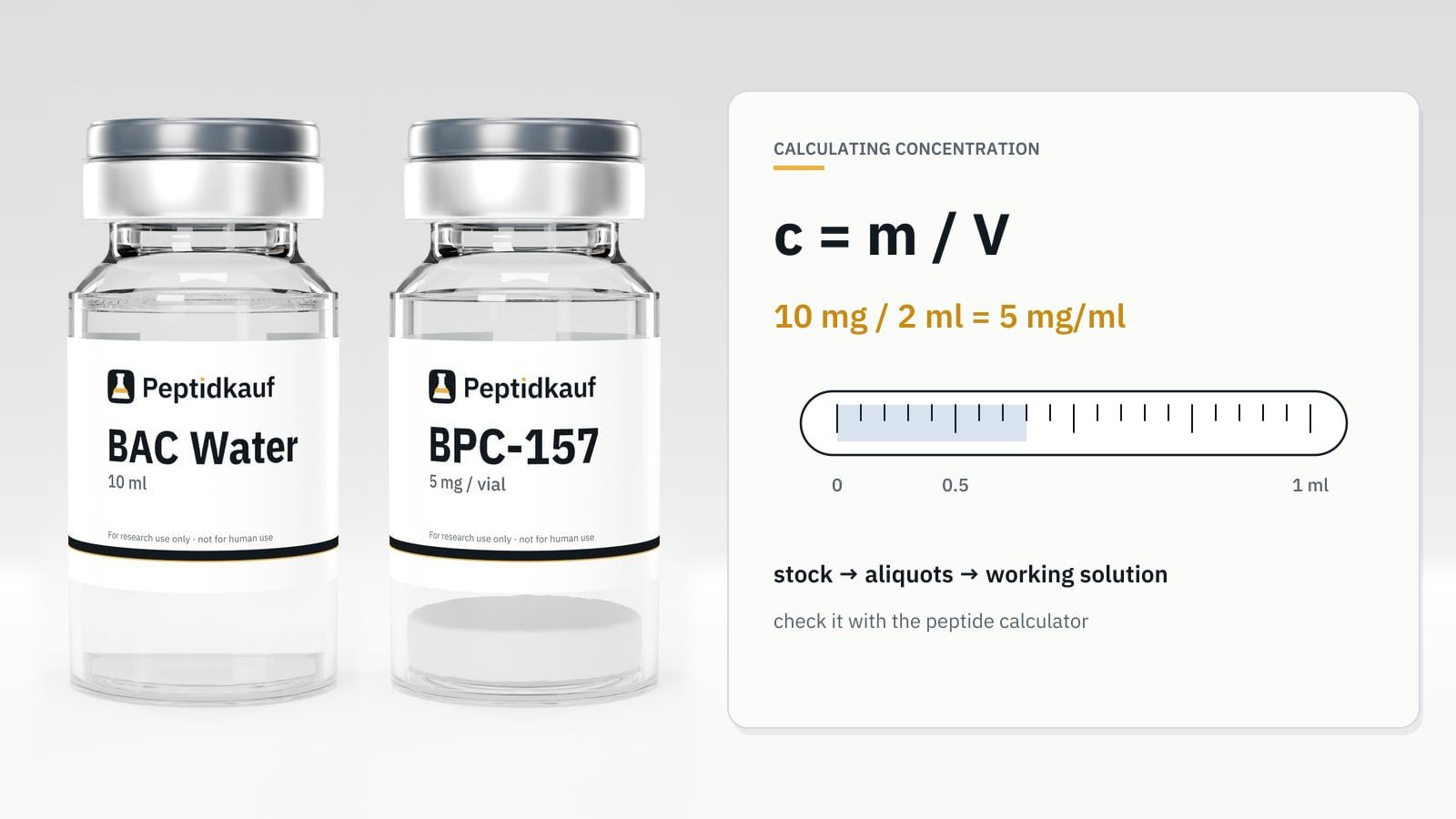
Before a peptide can be used in an experiment, the lyophilisate has to be dissolved. This step determines whether the calculated concentration is right and whether the material stays stable. The article describes reconstitution for in-vitro work — cell culture, biochemistry and analytics. It is not guidance for use in humans or animals.
Preparation
- Let the closed vial reach room temperature so no condensation forms.
- Briefly centrifuge or tap so the powder sits at the bottom.
- Have the certificate at hand: batch number and measured content are needed for the calculation.
Choosing a solvent
Solubility depends on the sequence. Net charge at neutral pH is a rough guide:
| Property | First attempt | Alternative |
|---|---|---|
| Basic (many Lys, Arg, His) | Sterile water | Dilute acetic acid (e.g. 10 %) |
| Acidic (many Asp, Glu) | Sterile water or buffer | Dilute ammonia / ammonium bicarbonate |
| Neutral, hydrophobic | Small fraction of DMSO, then dilute with buffer | Acetonitrile (not for cell work) |
| Contains Cys | Degassed, slightly acidic solution | Avoid DMSO (oxidation) |
For cell work, compatibility and final solvent concentration matter: DMSO is usually kept below 0.1–0.5 % in the medium. Bacteriostatic water contains 0.9 % benzyl alcohol and is unsuitable for many cell assays. With unknown solubility, test a small portion first.
Dissolving
- Add solvent slowly down the vial wall.
- Swirl or roll gently; do not shake vigorously.
- If needed, sonicate briefly; avoid heating.
- Check visually: clear, no particles, no streaks.
Calculating the concentration
Mass concentration is peptide amount divided by volume. For molar concentration, divide additionally by the molar mass, listed in the Peptide lexicon.
c (mg/ml) = peptide amount (mg) ÷ volume (ml) c (mM) = c (mg/ml) ÷ molar mass (g/mol) × 1000
Example: 5 mg in 2.5 ml gives 2 mg/ml. With a molar mass of 1419.5 g/mol that is about 1.41 mM.
Where possible, calculate with the content measured on the certificate rather than the nominal amount — see Endotoxin and water content.
Concentration calculator (in vitro)
Stock solution: 5 mg/ml = 5 µg/µl = 5,000 µg/ml
Dilution (C₁·V₁ = C₂·V₂)
Required volume of stock solution: 200 µl (0.2 ml)
Calculation aid for laboratory solutions. No dosing information.
Stock and working solutions
A concentrated stock is usually more stable than a highly diluted working solution. Dilutions follow the familiar formula:
c₁ × V₁ = c₂ × V₂
To make 1 ml of a 10 µM working solution from a 1 mM stock, take 10 µl of stock and make up to 1 ml.
Aliquoting and storage
- Split the stock into single-day portions immediately.
- Use low-protein-binding tubes.
- Store at −20 °C or −80 °C; avoid repeated thawing.
- Label each aliquot with peptide, batch, concentration, solvent and date.
Documentation
Record in the lab notebook: batch and certificate, amount used, solvent and volume, calculated concentration, number and location of aliquots. That keeps every result traceable to a tested batch — see Batches & traceability.
Conclusion
Careful reconstitution means the right solvent, correct calculation based on measured content, gentle dissolving and consistent aliquoting. More storage rules on the Storage & handling page.