Endotoxin and water content: what HPLC purity does not show
Peptidkauf Redaktion2 min read
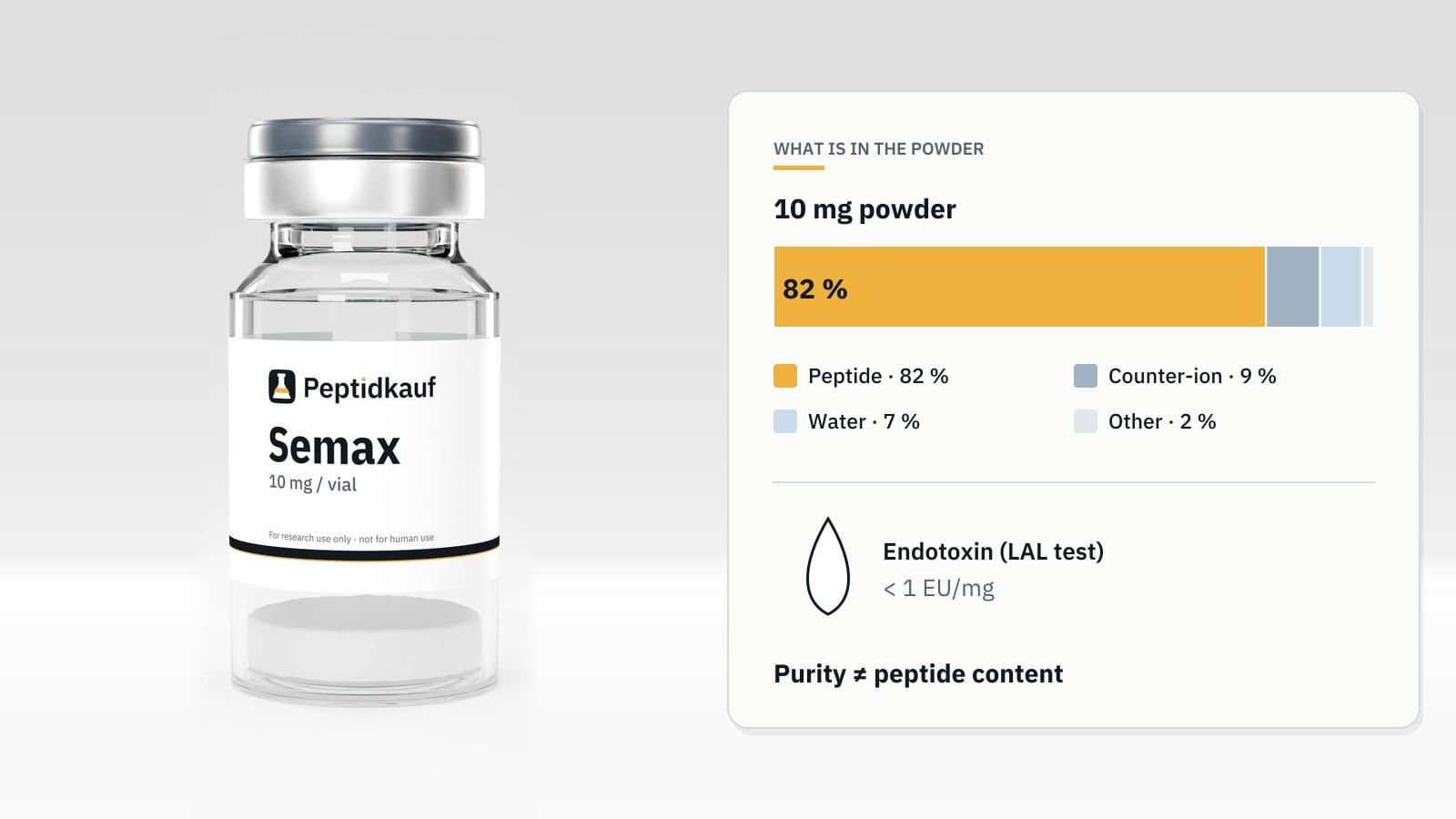
An HPLC purity of 99 % means 99 % of the UV-visible components are the target sequence. It does not mean 99 % of the weighed material is peptide. Lyophilisates also contain water and counter-ions, and for cell work endotoxins are a separate parameter. This article explains the three and how they are measured.
Gross weight, net peptide and purity
Three figures are often confused:
| Term | Question | Typical method |
|---|---|---|
| HPLC purity | What share of peptide components is the target sequence? | RP-HPLC, UV 214/220 nm |
| Net peptide content | What share of the weighed material is peptide? | Amino acid analysis, nitrogen determination |
| Content per vial | How much peptide is in the vial? | Quantitative HPLC against a reference standard |
Net peptide content of synthetic peptides is often between 70 and 90 %. The rest is mainly counter-ions and residual water.
Counter-ions
Peptides with basic residues such as lysine or arginine carry positive charges. During purification negatively charged counter-ions attach — usually trifluoroacetate (TFA) from the mobile phase, or acetate after salt exchange. They are tightly bound and weighed along with the peptide; the more basic residues, the larger their share. For cell work the salt form can matter, since TFA at higher concentrations can affect cells; many peptides are therefore supplied as acetate.
Water content
Lyophilisates are dry but not anhydrous. Peptides are hygroscopic and bind residual moisture. Water content is usually measured by Karl Fischer titration and is typically in the single-digit per cent range. Opening a cold vial lets condensation raise it significantly — one reason to bring vials to room temperature first. See Storage & handling.
Endotoxins
Endotoxins are components of the outer membrane of Gram-negative bacteria (lipopolysaccharides). They are heat-stable and can activate immune cells in very small amounts, distorting results in cell cultures, especially with macrophages or other immune cells. They are measured with the LAL (Limulus amebocyte lysate) test or recombinant factor C assays and reported in endotoxin units per milligram (EU/mg). Not every certificate includes this test; for endotoxin-sensitive experiments your own measurement is worthwhile.
What this means for your calculations
If you need an exact molar concentration, the gross amount is not enough. A pragmatic order:
- If the certificate gives a measured content per vial, use that value.
- If a net peptide content is given, multiply the gross amount by it.
- If neither is given, record that the gross amount was used.
Certificates in the Peptidkauf range state the measured content per batch; find them in the lab report archive. The calculator in Reconstitution in vitro helps with conversions.
Conclusion
Purity, net peptide content and endotoxin load answer three different questions. Keeping them apart means correct concentrations and the ability to rule out confounders in cell experiments. More on purity: How to read a chromatogram.