MOTS-c: effects and research status of the mitochondrial peptide
Peptidkauf Redaktion3 min read
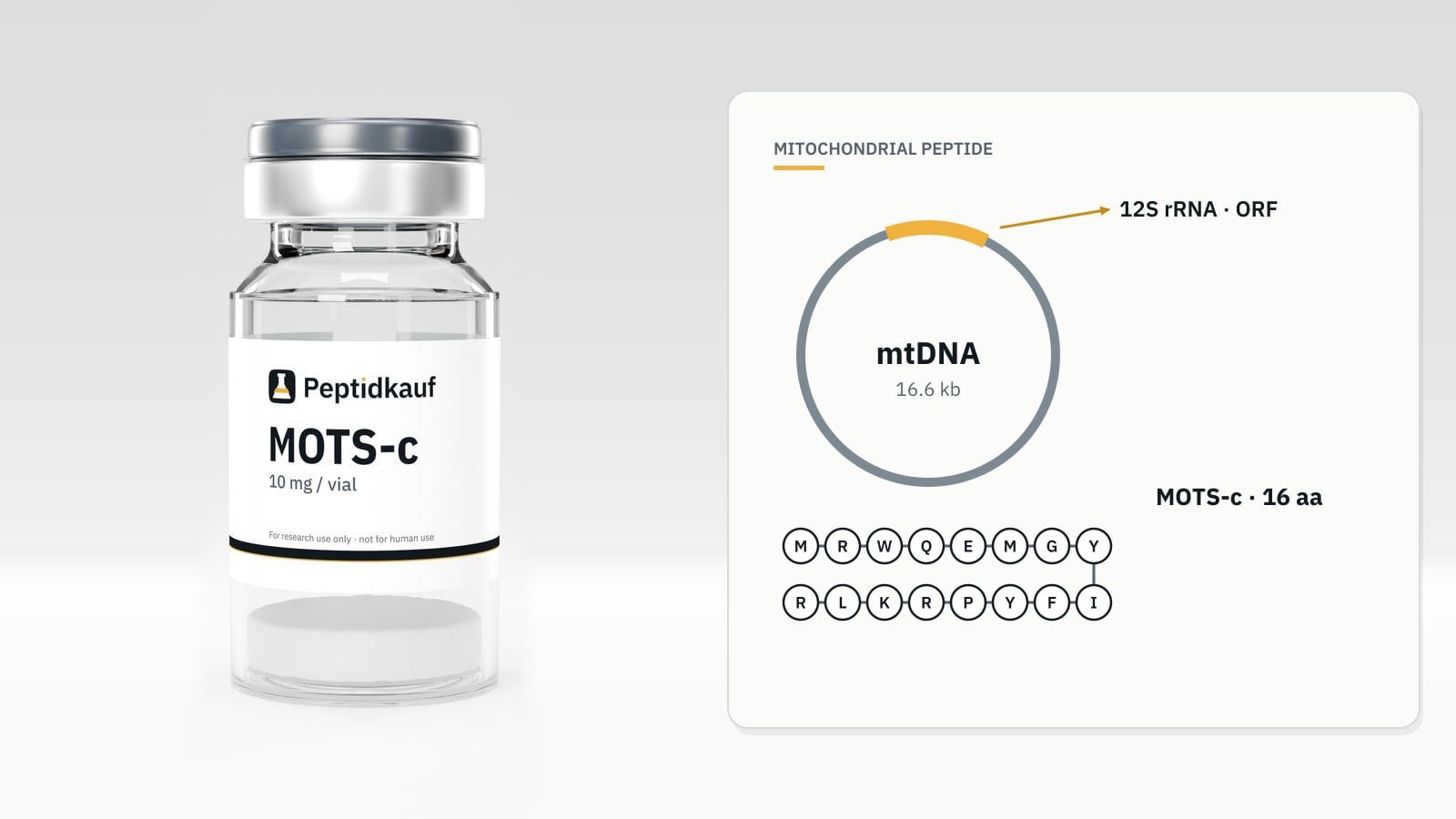
For a long time mitochondrial DNA was considered dull: 37 genes, all for energy production, nothing else. MOTS-c changed that picture. The 16-amino-acid peptide is encoded in a section of mitochondrial DNA that actually codes for a ribosome component, and appears to act as a signal from the mitochondria to the rest of the cell. This article explains how MOTS-c was discovered, what it does in models and why the human findings are still very preliminary. It contains no usage or dosing advice.
At a glance
- MOTS-c stands for 'mitochondrial ORF of the 12S rRNA type-c'; its sequence is MRWQEMGYIFYPRKLR.
- It was described in 2015 and activates the energy sensor AMPK in cells.
- In mice it protected against diet-induced insulin resistance and improved the physical capacity of older animals.
- In humans mainly blood levels have been measured; studies with administered MOTS-c are missing.
A gene within a gene
Researchers led by Changhan Lee at the University of Southern California searched mitochondrial DNA for short reading frames that might encode further peptides. In the 12S rRNA section they found one and described its peptide, MOTS-c, in Cell Metabolism in 2015. MOTS-c thus belongs to the mitochondrially encoded peptides, a young group that also includes humanin.
How MOTS-c acts in the cell
The first description showed that MOTS-c inhibits part of folate metabolism, causing an intermediate called AICAR to accumulate. AICAR activates AMPK, the cell's central energy sensor, which promotes glucose uptake and fat oxidation, much as exercise does. AICAR itself has long been used in research to activate AMPK directly; MOTS-c reaches the same target by an endogenous route. Later work showed that MOTS-c moves into the nucleus under stress and influences stress-protective genes.
What mouse studies show
| Model | Reported finding |
|---|---|
| Mice on a high-fat diet | Less weight gain and better insulin sensitivity |
| Older mice | Better physical capacity and muscle function |
| Muscle wasting models | Signs of preserved muscle mass |
The findings come from several papers, mostly from the discoverers' circle.
What is known in humans
So far MOTS-c has mainly been measured, not administered, in humans. Some studies found blood levels rise after exercise; others looked at associations with age or metabolic disease. Such observations show associations, not causes. There are no completed efficacy studies with MOTS-c itself.
Limits of the research
The research community is small and independent replications are rare; it is unclear how stable MOTS-c is in blood and what reaches tissue; human safety data are entirely missing. Claims such as 'MOTS-c improves metabolism' go beyond the data.
MOTS-c and SS-31
Both relate to mitochondria but very differently: MOTS-c is an endogenous signalling peptide, SS-31 a synthetic molecule that binds the inner mitochondrial membrane. See MOTS-c vs. SS-31.
In the lab
With 16 amino acids and 2,174.6 g/mol, MOTS-c is stable freeze-dried and sensitive in solution; prepare solutions fresh and keep them cold. MOTS-c is available with an independent report for every batch, also in the NAD+ + MOTS-c + 5-Amino-1MQ blend.
Frequently asked questions
What is MOTS-c?
A 16-amino-acid peptide encoded in mitochondrial DNA that activates the energy sensor AMPK in cells.
What effects does MOTS-c have?
In mice it protected against insulin resistance and improved the capacity of older animals; effects in humans have not been studied.
Is MOTS-c approved?
No. It is not a medicine and not in advanced clinical development.
Conclusion
MOTS-c broadened the view of mitochondria: they appear to send their own signals to the cell. Effects on energy metabolism are well described in cells and mice; in humans research is only beginning.