Kisspeptin: effects, discovery and research on the puberty switch
Peptidkauf Redaktion3 min read
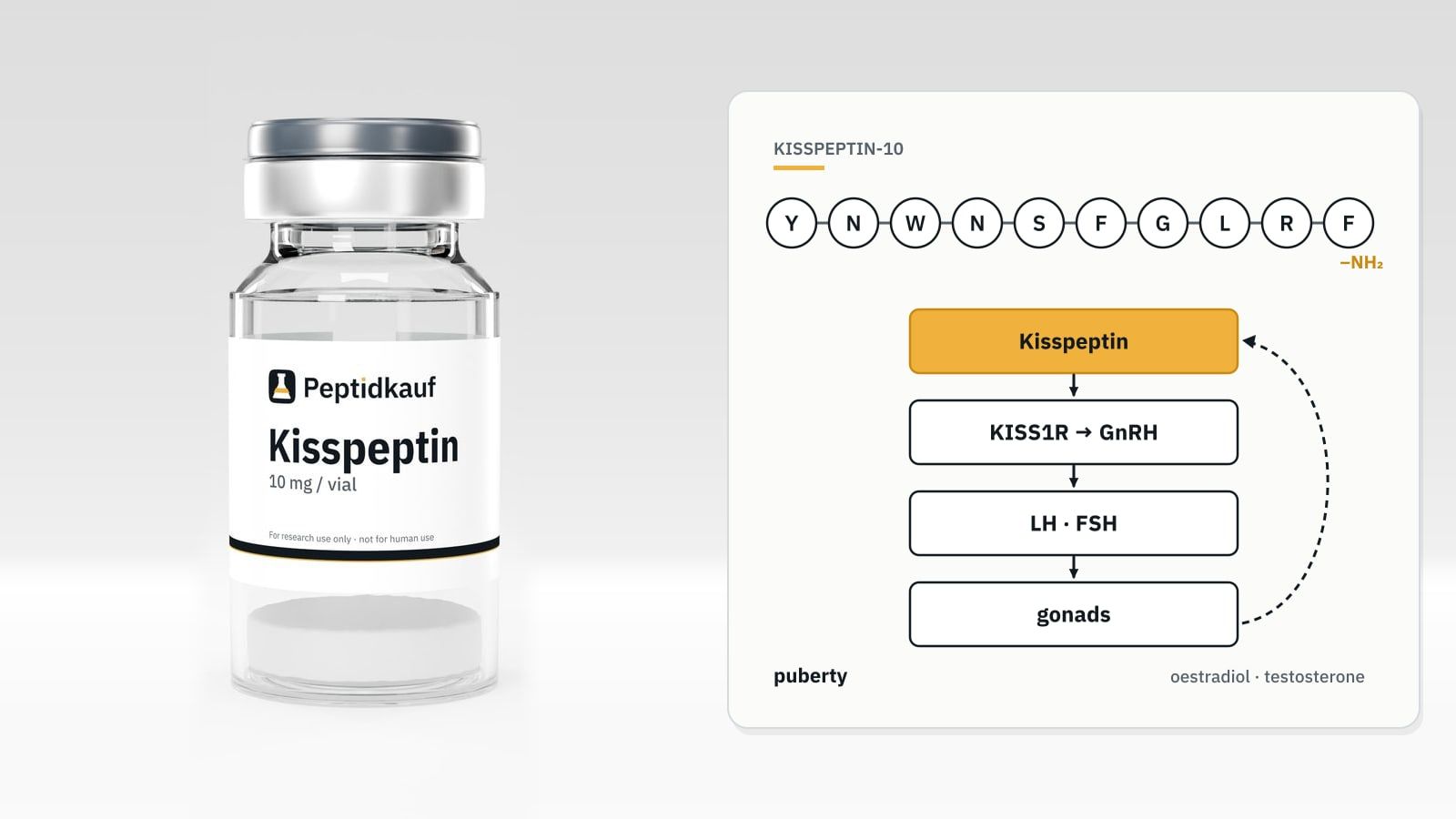
Kisspeptin is a relatively young topic in hormone research, but a fundamental one: without kisspeptin, puberty does not start. The peptide sits at the top of the hormonal axis that controls fertility, which makes it an important tool for reproductive research. This article explains how kisspeptin was discovered, how it works and what animal and human studies show. It describes research and contains no usage or dosing advice.
At a glance
- Kisspeptins are peptides from the KISS1 gene; the shortest active form, kisspeptin-10, has ten amino acids.
- They activate the receptor KISS1R (GPR54) on GnRH neurons in the hypothalamus.
- Without the receptor, puberty does not begin. Kisspeptin is therefore considered the "switch" of the reproductive axis.
- In humans, kisspeptin has been studied in assisted reproduction and brain activity; it is not approved.
How kisspeptin was discovered
In 1996 researchers in Hershey, Pennsylvania, described a gene that suppressed metastasis of melanoma cells. They named it KISS1, after the town's chocolate "Kisses". The resulting peptide was first called metastin.
Its real significance emerged in 2003: two groups independently found that people with mutations in the receptor GPR54 do not enter puberty. That made it clear that kisspeptin is indispensable for the reproductive axis.
How does kisspeptin work?
Reproduction is controlled by a hormone cascade:
- Kisspeptin from hypothalamic neurons activates the receptor KISS1R on GnRH neurons.
- GnRH is released in pulses and reaches the pituitary.
- LH and FSH from the pituitary control the ovaries and testes.
- Sex hormones such as oestradiol and testosterone feed back via kisspeptin neurons.
Kisspeptin is thus the pacemaker above GnRH. It translates signals such as energy balance, stress and season into the control of fertility. More on GnRH on the gonadorelin page.
The forms
| Form | Length | Feature |
|---|---|---|
| Kisspeptin-54 (metastin) | 54 amino acids | Longest form, more stable in blood |
| Kisspeptin-14, -13 | 14 and 13 amino acids | Shortened forms |
| Kisspeptin-10 | 10 amino acids (YNWNSFGLRF-NH₂) | Shortest fully active section, rapid breakdown |
All forms share the C-terminal end that activates the receptor.
What do the studies show?
Puberty and fertility in animal models
In rodents and primates kisspeptin rapidly triggers LH surges. Animals without a functioning kisspeptin system remain infertile. Continuous exposure, by contrast, can desensitise the receptor, an effect also known from GnRH analogues.
Assisted reproduction
A group at Imperial College London studied kisspeptin-54 as a trigger of egg maturation in in-vitro fertilisation. The idea: kisspeptin stimulates the body's own LH release and could thereby lower the risk of ovarian hyperstimulation seen with hCG. The studies reported successful egg maturation and pregnancies; this is early clinical research.
Brain and behaviour
Functional imaging studies described that kisspeptin changes activity in brain regions involved in sexual and emotional processing. These findings are new and come from small studies.
Safety and status
In the human studies so far, kisspeptin was well tolerated. It is not approved as a medicine. As a substance that stimulates LH release, it may fall under anti-doping rules.
Kisspeptin in the lab
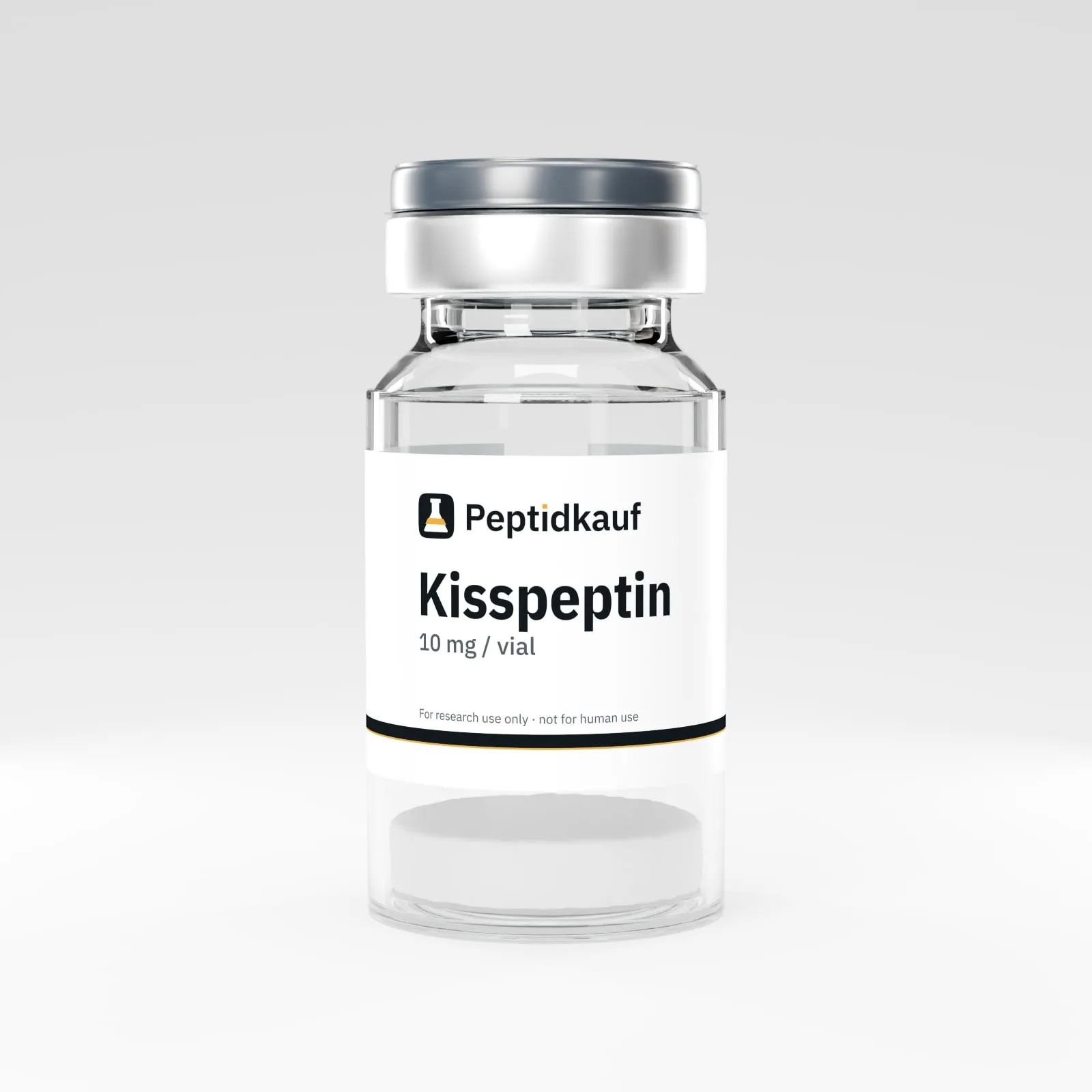
Research mainly uses kisspeptin-10 to study GnRH neuron activation, the pulsatility of LH release and feedback by sex hormones. Its short half-life suits experiments with clearly limited signals. Peptidkauf offers kisspeptin-10 as a research reagent with a lab report for every batch; related tools of the axis are gonadorelin, alarelin and HCG.
Frequently asked questions
What is kisspeptin?
A peptide hormone from the hypothalamus that activates GnRH neurons and thereby controls the reproductive axis.
What does kisspeptin do in the body?
Via GnRH it triggers the release of LH and FSH and is indispensable for the onset of puberty.
What is the difference between kisspeptin-10 and kisspeptin-54?
Both activate the same receptor. Kisspeptin-54 is the long form, more stable in blood; kisspeptin-10 is the shortest active section.
Is kisspeptin approved?
No. It is being studied in clinical trials but is not approved as a medicine.
Conclusion
Kisspeptin is the switch at the top of the reproductive axis: without it, no GnRH pulse, no puberty, no fertility. The basic research is solid and the clinical research promising but young. For laboratory work on hormone control, kisspeptin-10 is a precise tool.