HGH or peptides? Somatropin and GH secretagogues compared
Peptidkauf Redaktion4 min read
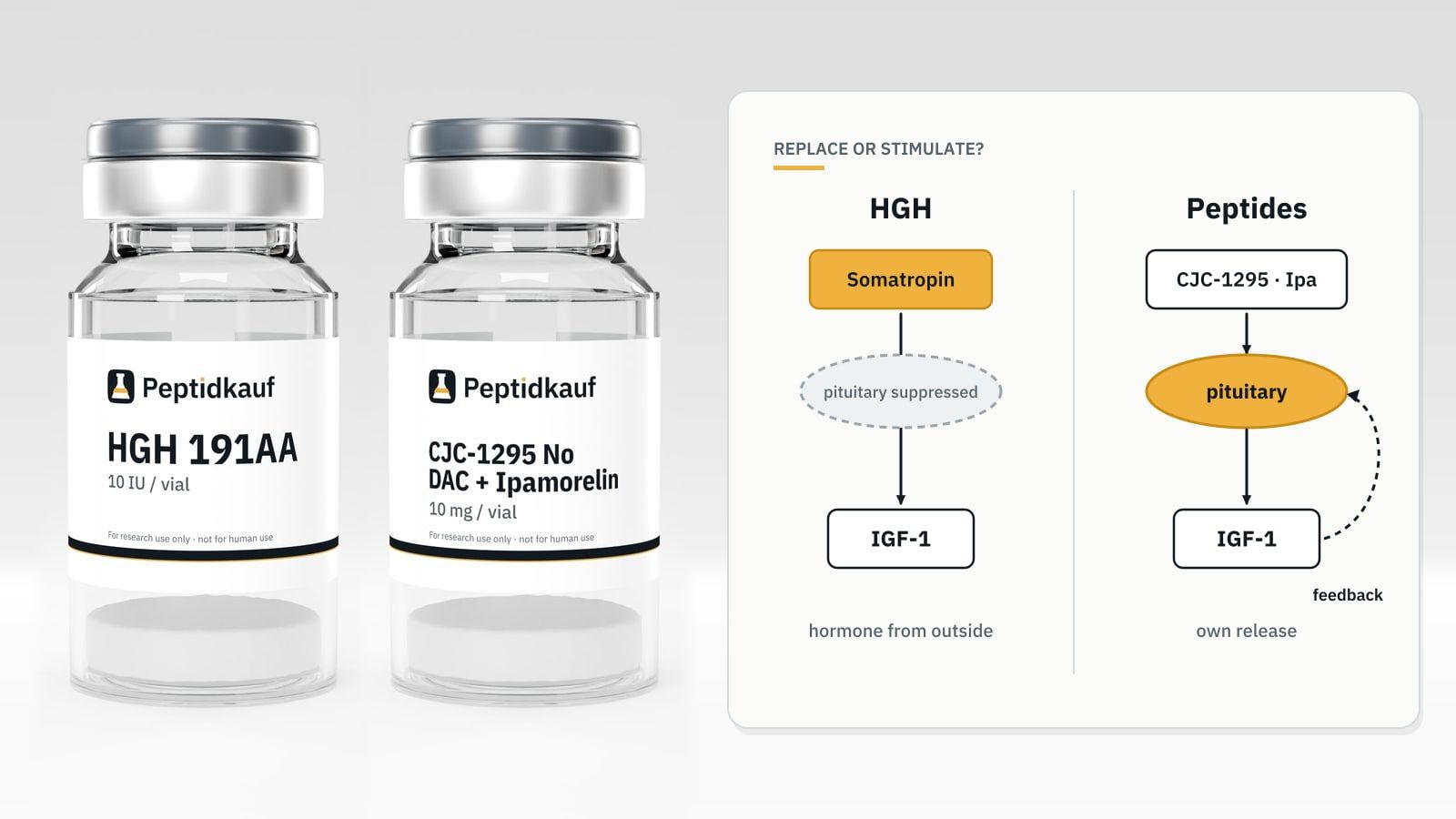
"HGH or peptides?" is one of the most common questions in growth hormone research. It is about the difference between the hormone itself, recombinant somatropin, and peptides that stimulate the pituitary to release more of its own growth hormone. Both ultimately raise GH and IGF-1, but by fundamentally different routes, with different consequences for the body's control systems and a very different approval status. This article compares the two approaches. It describes research and contains no usage or dosing advice.
At a glance
- HGH (somatropin) is growth hormone itself, a 191-amino-acid protein. It replaces the body's own release.
- GH secretagogues such as CJC-1295, tesamorelin and ipamorelin are peptides that stimulate the body's own pituitary.
- With secretagogues, pulse pattern and feedback are preserved; they only work with a functioning pituitary.
- Somatropin is approved for several indications; among the secretagogues only tesamorelin, in the US. All are on the WADA Prohibited List.
What is HGH?
HGH stands for human growth hormone; the drug name is somatropin. It is a 191-amino-acid protein with two disulfide bridges that the pituitary releases in pulses, mostly at night. It has been produced recombinantly since 1985; before that it came from the pituitaries of deceased donors, which transmitted Creutzfeldt-Jakob disease and was stopped.
Somatropin is approved for, among others, growth hormone deficiency in children and adults, Turner and Prader-Willi syndrome and chronic kidney disease in childhood. Long-acting weekly forms now exist as well. More on the molecule on the HGH 191AA page.
What are GH peptides?
GH peptides, more precisely growth hormone secretagogues, add no hormone from outside but signal the pituitary. There are two families:
- GHRH analogues such as sermorelin, CJC-1295 and tesamorelin act at the GHRH receptor.
- Ghrelin mimetics such as ipamorelin, GHRP-2 and GHRP-6 act at the ghrelin receptor.
Explained in detail in ipamorelin, CJC-1295, tesamorelin & co..
The key difference: control
The growth hormone axis is a feedback loop. The hypothalamus accelerates with GHRH and brakes with somatostatin, and IGF-1 made in the liver reports back when enough hormone is acting.
| Feature | HGH (somatropin) | GH secretagogues |
|---|---|---|
| Mechanism | Hormone from outside | Stimulation of the body's own pituitary |
| Pulse pattern | Set by administration | Largely preserved |
| Feedback via IGF-1 and somatostatin | Bypassed | Remains active |
| Requirement | None | Functioning pituitary |
| Own GH production | Suppressed | Stimulated |
| Approval | Several indications | Tesamorelin only (US) |
This leads to the most important practical difference: in a deficiency where the pituitary cannot make growth hormone, secretagogues do not help. Conversely, the preserved feedback limits how high GH and IGF-1 can rise with secretagogues.
What do the studies show?
Somatropin has decades of clinical experience with thousands of patients in its approved indications. For the secretagogues the evidence is thinner: tesamorelin has phase 3 trials in HIV lipodystrophy (see tesamorelin: effects, studies and approval), CJC-1295 DAC early studies in healthy volunteers, ipamorelin a failed phase 2 trial (see ipamorelin: effects and evidence). Direct comparisons between HGH and secretagogues hardly exist.
Risks
Both approaches share the typical consequences of raised GH and IGF-1: water retention, joint and muscle pain, tingling in the hands and reduced insulin sensitivity. Because IGF-1 promotes cell growth, long-term raised levels are also discussed in research in connection with cancer risk. With somatropin, levels can rise far above the natural range; with secretagogues the feedback limits the height but does not rule out side effects. Older GHRPs also raise cortisol, prolactin and appetite.
Doping and the law
Growth hormone and all GH-releasing factors are on the World Anti-Doping Agency's prohibited list. Somatropin is prescription-only. The peptides, except tesamorelin in the US, are not approved as medicines and are offered as research reagents.
What about "HGH fragment 176-191"?
Despite the name, the fragment is not growth hormone and does not stimulate its release. It is a short section from the end of the hormone that was studied for fat metabolism in animal models. More on the HGH fragment 176-191 page.
Frequently asked questions
What is the difference between HGH and peptides?
HGH is growth hormone itself. GH peptides stimulate the body's own pituitary to release more growth hormone and leave the body's own control in place.
Which is better, HGH or peptides?
It depends on the question. In research, HGH is the reference for hormone action and secretagogues are tools for the axis' physiology. Medically, only somatropin is broadly approved.
Do GH peptides work without a pituitary?
No. Secretagogues need a functioning pituitary because they only stimulate its own release.
Are HGH and GH peptides allowed in sport?
No. Both are on the WADA Prohibited List.
Conclusion
HGH and GH peptides pursue the same goal by different routes: replacing the hormone versus stimulating its own production. The differences lie in control, evidence and approval status. In research they complement each other; for statements about benefits and risks in humans, somatropin is far better studied.