GHK-Cu serum and peptide creams: what research shows about copper peptides in skincare
Peptidkauf Redaktion5 min read
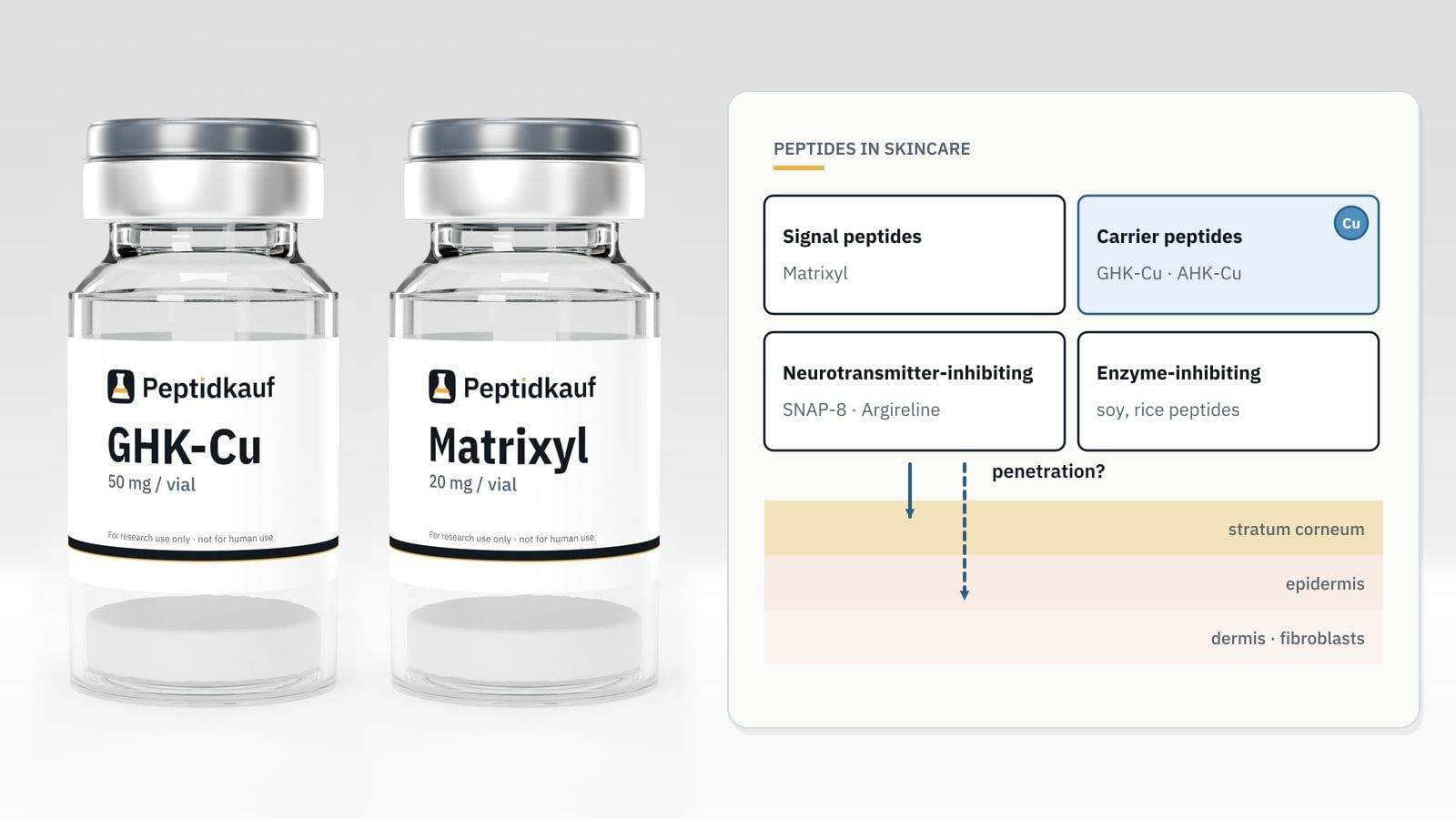
"GHK-Cu serum", "copper peptide serum" and "peptide cream" are among the most searched skincare terms. Behind the products lies real research, but also a lot of marketing. This article explains which kinds of peptides are used in serums and creams, what studies on copper peptides such as GHK-Cu actually show, where the limits are and why a research reagent is something different from a cosmetic product. It describes research and contains no usage advice.
At a glance
- Cosmetic peptides fall into four classes: signal peptides, carrier peptides (such as GHK-Cu), neurotransmitter-inhibiting peptides and enzyme-inhibiting peptides.
- GHK-Cu stimulates collagen and elastin production in cell culture; clinical data come mostly from small cream studies.
- A key problem is skin penetration: peptides pass the outer skin layer only to a limited extent.
- Research reagents are not cosmetics. In the EU, cosmetics need their own safety assessment.
Which peptides are in serums and creams?
Cosmetic science distinguishes four groups according to how a peptide is meant to act in the skin:
| Class | Principle | Examples |
|---|---|---|
| Signal peptides | Fragments of matrix proteins signal fibroblasts to make more collagen | Matrixyl (palmitoyl pentapeptide-4) |
| Carrier peptides | Deliver trace elements such as copper to tissue repair enzymes | GHK-Cu, AHK-Cu |
| Neurotransmitter-inhibiting peptides | Dampen signalling to muscle cells, based on SNARE proteins | Argireline, SNAP-8 |
| Enzyme-inhibiting peptides | Slow enzymes that break down collagen | Peptides from soy or rice protein |
Most serums combine several classes. Signal peptides and copper peptides are the best studied.
GHK-Cu: the best-known copper peptide
GHK is a tripeptide of glycine, histidine and lysine that Loren Pickart discovered in human blood plasma in 1973. It binds copper ions very tightly; the GHK-Cu complex is deep blue. Plasma levels fall markedly with age, which made GHK-Cu interesting for ageing research early on. In cosmetics the substance is called "copper tripeptide-1".
What laboratory studies show
In cultures of skin fibroblasts, GHK-Cu stimulates the production of collagen, elastin and glycosaminoglycans. It also influences enzymes that break down old matrix, so the result is remodelling rather than mere accumulation. Gene expression analyses describe effects on hundreds of tissue repair and inflammation genes. In animal wound models GHK-Cu accelerated healing.
What human studies show
Clinical data come mainly from small studies with creams in the 1990s and 2000s, usually over eight to twelve weeks. They reported more collagen in skin biopsies, improved skin density and fewer fine lines compared with a control cream. The studies are small, often manufacturer-funded and rarely replicated independently. Large placebo-controlled trials are lacking. More on the evidence in GHK-Cu in research.
Copper peptides and hair
In hair research, AHK-Cu is the most cited copper peptide: on isolated human hair follicles it promoted elongation and papilla cell division. Clinical studies of copper peptide scalp serums are scarce. The difference between the two peptides is shown in GHK-Cu vs. AHK-Cu.
Matrixyl, SNAP-8 and Argireline
- Matrixyl (palmitoyl pentapeptide-4) is a type I procollagen fragment with an attached fatty acid. A controlled study of 93 women found fewer fine lines after twelve weeks than with the vehicle alone. More on the Matrixyl page.
- Argireline and SNAP-8 are short sections of the SNARE protein SNAP-25 and are meant to dampen messenger release at the nerve-muscle junction. Effects in studies are much smaller than those of botulinum toxin, and how much peptide reaches the muscle at all is disputed. More on the SNAP-8 page.
The big question: does the peptide get there?
The outer layer of the skin is an effective barrier against large and water-soluble molecules, and peptides are both. Research therefore uses several strategies:
- Fatty acid attachments, as in palmitoyl peptides, to increase lipid solubility.
- Liposomes and nanocarriers that package peptides.
- Microneedling, which opens small channels in the outer layer; there are studies with copper peptides.
For most finished serums, how much peptide actually reaches the living skin layer has not been measured.
Stability of copper peptides in formulations
For formulation research a few properties matter:
- pH: at strongly acidic pH the copper dissociates from the complex, so copper peptides are considered hard to combine with acidic actives.
- Vitamin C: copper ions accelerate the oxidation of ascorbic acid, so combining both in one formulation is tricky.
- Colour: GHK-Cu turns solutions blue. A colourless "copper peptide serum" contains little copper or copper bound differently.
Research reagent or cosmetic?
A drugstore serum and a research reagent may contain the same substance but differ legally and practically:
| Feature | Cosmetic product | Research reagent |
|---|---|---|
| Purpose | Application to the skin | Laboratory and in-vitro experiments |
| EU legal framework | Cosmetics Regulation with safety assessment | Laboratory chemical |
| Form | Finished formulation | Pure lyophilised powder |
| Evidence | Ingredient list (INCI) | Lab report with purity and content for every batch |
Peptidkauf sells GHK-Cu, AHK-Cu, Matrixyl and SNAP-8 solely as research reagents with a lab report for every batch, not as cosmetics and not for use on the skin. All skin peptides at a glance: skin and copper peptides research area.
Frequently asked questions
What is a GHK-Cu serum?
A cosmetic serum containing the copper peptide GHK-Cu (copper tripeptide-1). It is meant to support collagen production; the clinical evidence comes from small studies.
Do peptide creams work?
For some peptides, such as Matrixyl and GHK-Cu, small controlled studies show measurable effects on fine lines and collagen. Large independent studies are lacking, and skin penetration is limited.
What is the difference between GHK-Cu and AHK-Cu?
Both are copper complexes of tripeptides. GHK-Cu is studied mainly for collagen and wound healing, AHK-Cu mainly on hair follicles.
Can GHK-Cu be combined with vitamin C?
Copper ions accelerate vitamin C oxidation, and acidic pH releases copper from the complex. In formulation research the combination is therefore considered problematic.
Is a research reagent suitable for skincare?
No. Research reagents are intended for laboratory experiments and have no cosmetic safety assessment.
Conclusion
Peptides in serums and creams rest on real research, especially copper and signal peptides. The laboratory findings are convincing, the clinical evidence small, and how much peptide reaches living skin is often open. Studying the mechanisms calls for pure, analysed substances; skincare calls for a tested cosmetic product.