


What is AHK-Cu?
AHK-Cu consists of alanine, histidine and lysine binding a Cu²⁺ ion via histidine and the N-terminus — analogous to GHK-Cu, with alanine instead of glycine.
More data in the lexicon entry on AHK-Cu.
State of research
In research on peptides and hair growth, AHK-Cu is one of the most cited molecules. A study on isolated human hair follicles (Pyo et al., 2007) reported that AHK-Cu promoted follicle elongation, stimulated dermal papilla cell proliferation and reduced programmed cell death, measured by the ratio of the proteins Bcl-2 and Bax.
Further work examines how AHK-Cu influences collagen production in fibroblasts and how replacing glycine with alanine affects copper binding. Clinical hair growth studies are still lacking. How the two copper peptides differ is shown in GHK-Cu vs. AHK-Cu.
Status and quality
AHK-Cu is known as a cosmetic ingredient (copper tripeptide-3) but is not approved as a medicine. Peptidkauf sells AHK-Cu solely as a research reagent for laboratory and in-vitro use and gives no dosing or application advice.
An independent laboratory tests every batch for purity (HPLC), identity and measured content before it goes on sale; the reports and their verification keys are in the lab report archive. The material ships as lyophilised powder in a glass vial; storage and laboratory handling are covered under storage & handling.
Related products and articles
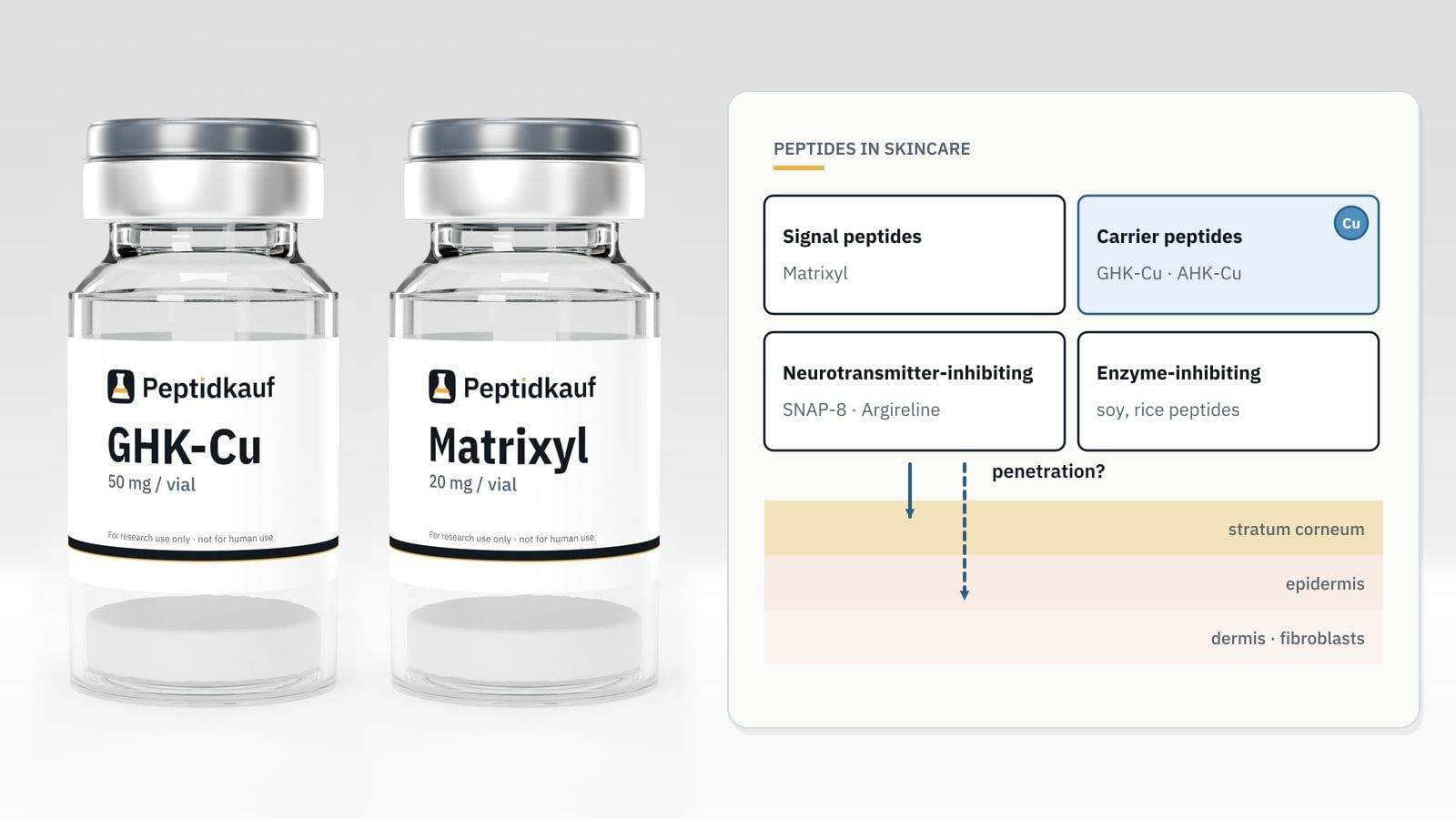
The better-known copper peptide: GHK-Cu. More skin peptides: Matrixyl, SNAP-8. All compounds in the skin and copper peptides research area.