GHK-Cu: the copper peptide between lab and cosmetics
Peptidkauf Redaktion3 min read
GHK-Cu turns up in two very different places: on the shelf of anti-ageing serums and in the catalogue of research peptides. Both share one origin, a tiny copper-binding peptide found in human blood. What it actually does in studies depends heavily on the form and model in which it was examined. This article separates the levels: cell biology, animal models, cosmetic studies and what remains open. It contains no usage or dosing advice.
At a glance
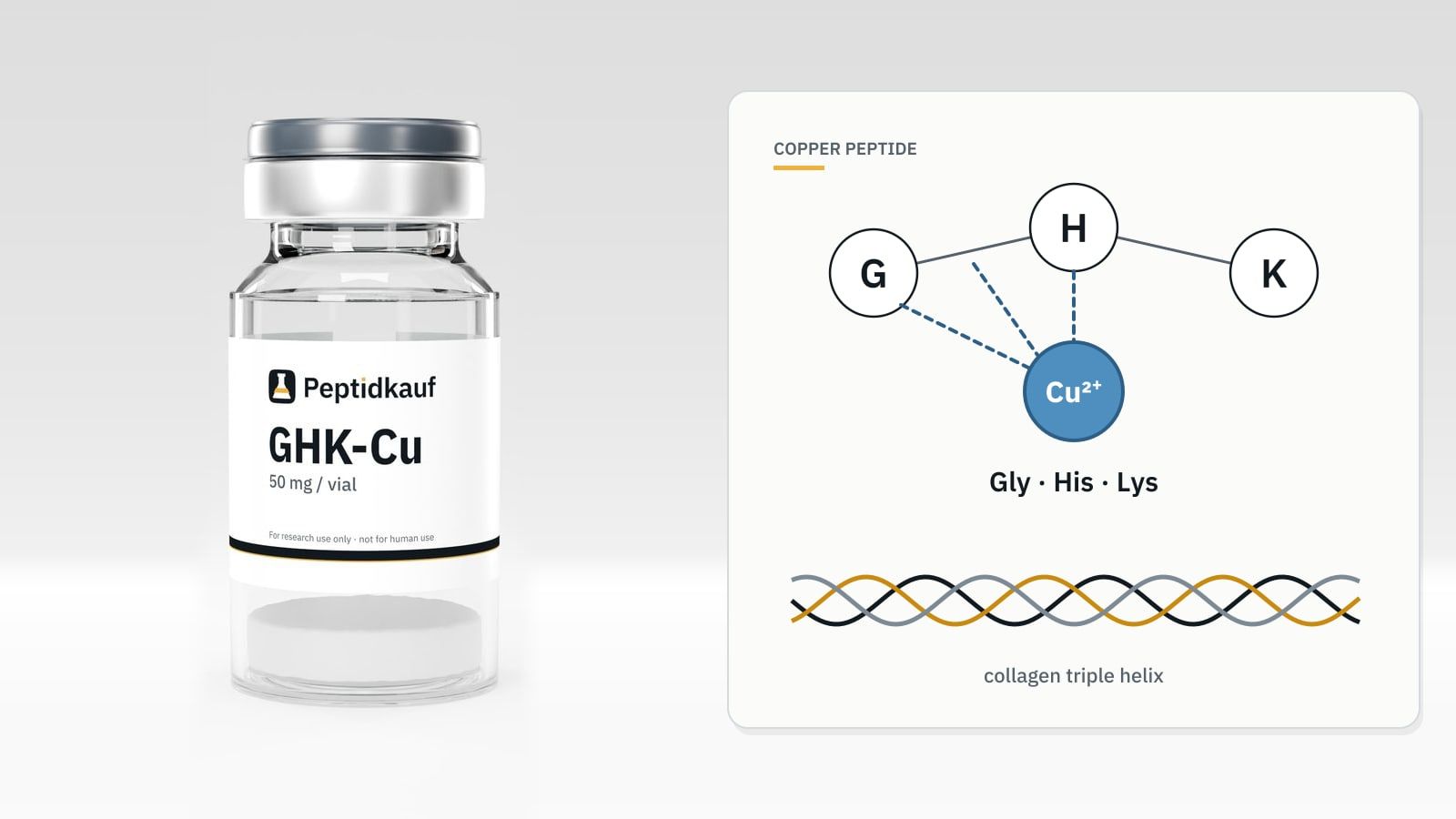
- GHK is the tripeptide glycine-histidine-lysine; with bound copper(II) it is called GHK-Cu, in cosmetics copper tripeptide-1.
- In cell cultures GHK-Cu increased the production of collagen and other connective-tissue components.
- In animal wound models, wounds healed faster.
- In humans there are mainly small cosmetic studies; data for other forms are missing.
Where GHK-Cu comes from
In 1973 the biochemist Loren Pickart described GHK while investigating why plasma from young people changed the behaviour of liver cells from older donors in culture. The responsible factor was a three-amino-acid peptide that binds copper ions exceptionally tightly. Later measurements suggested that plasma GHK levels fall with age.
What GHK-Cu does in cells
In fibroblast cultures, studies described more collagen and elastin, more water-binding glycosaminoglycans and a shifted balance between connective-tissue-degrading enzymes and their inhibitors. A widely cited analysis of gene expression data concluded that GHK shifts the activity of many genes towards a 'healthier' pattern. Such analyses are a hint, not proof of an effect in tissue.
What animal models show
In wound models in rats, rabbits and pigs, wounds closed faster under GHK-Cu, more blood vessels formed and scar structure was more orderly. These are among the most robust findings in the GHK literature because several groups described them in several models.
GHK-Cu serums and creams
| Feature | Typical of cosmetic GHK-Cu studies |
|---|---|
| Participants | A few dozen, often middle-aged women |
| Duration | Weeks to a few months |
| Measures | Skin density, moisture, wrinkle depth, self-assessment |
| Funding | Frequently manufacturers |
Results were mostly positive but small and rarely replicated independently. How much of a charged peptide passes the intact skin barrier depends heavily on the formulation, so cream study results transfer neither to other products nor to other forms.
Research reagent or cosmetic?
A cosmetic is a finished formulation with a low GHK-Cu concentration, preservation and tested skin tolerance. A research reagent is the pure freeze-dried peptide in larger amounts, for preparing defined solutions in the lab. It is not a cosmetic and not intended for the skin. The pure lyophilisate is available as GHK-Cu with a report for every batch.
Side effects and safety
At cosmetic concentrations GHK-Cu is considered well tolerated, with occasional skin irritation reported. For higher concentrations and other forms there are no systematic human safety data.
Related copper peptides
AHK-Cu replaces glycine with alanine and is studied mainly in hair follicle models; see GHK-Cu vs. AHK-Cu. GHK-Cu is also part of the GLOW blend and, with KPV, the GHK-Cu + KPV blend.
Frequently asked questions
What does GHK-Cu do?
In cell culture it increases collagen and other connective-tissue components; in animal models it accelerated wound healing.
Do GHK-Cu serums work?
Small cosmetic studies report slight improvements in skin density and wrinkles; data are limited and mostly manufacturer-funded.
Does GHK-Cu have side effects?
At cosmetic concentrations it is considered well tolerated; for other uses safety data are missing.
Conclusion
GHK-Cu is one of the few peptides with solid basic research: clear origin, reproducible effects in cells and wound models, widespread cosmetic use. Large independent human studies are what is missing.