NAD+ effects: what the coenzyme does in the cell and what studies show
Peptidkauf Redaktion5 min read
NAD+ is one of the most searched terms around ageing research and cellular energy. No surprise: the coenzyme takes part in hundreds of reactions, and in animal studies its level falls with age. A whole industry of capsules, infusions and precursors has grown from this. What is actually established about the effects of NAD+? This article explains what NAD+ and NADH do in the cell, what studies in animals and humans have shown and where the limits are. It describes research and contains no usage or dosing advice.
At a glance
- NAD+ (nicotinamide adenine dinucleotide) is a coenzyme in every cell. It carries electrons and is consumed as a substrate by enzymes such as sirtuins and PARP.
- NAD+ and NADH are the same molecule in two states: oxidised and reduced.
- In animal models the NAD+ content of many tissues falls with age; precursors such as NMN and NR raise it again.
- In humans, precursors raise NAD+ levels in blood. A clear health benefit has not been shown.
What is NAD+?
NAD+ stands for nicotinamide adenine dinucleotide. The molecule consists of two nucleotides joined by phosphate groups: one carries the base adenine, the other nicotinamide, a form of vitamin B3. The plus refers to the positive charge of the oxidised form.
The body makes NAD+ by three routes: from the amino acid tryptophan, from nicotinic acid (niacin) and, most importantly, through a recycling pathway from nicotinamide. This salvage pathway produces the intermediates NMN (nicotinamide mononucleotide) and NR (nicotinamide riboside), which are now sold as supplements.
NAD+ and NADH: the difference
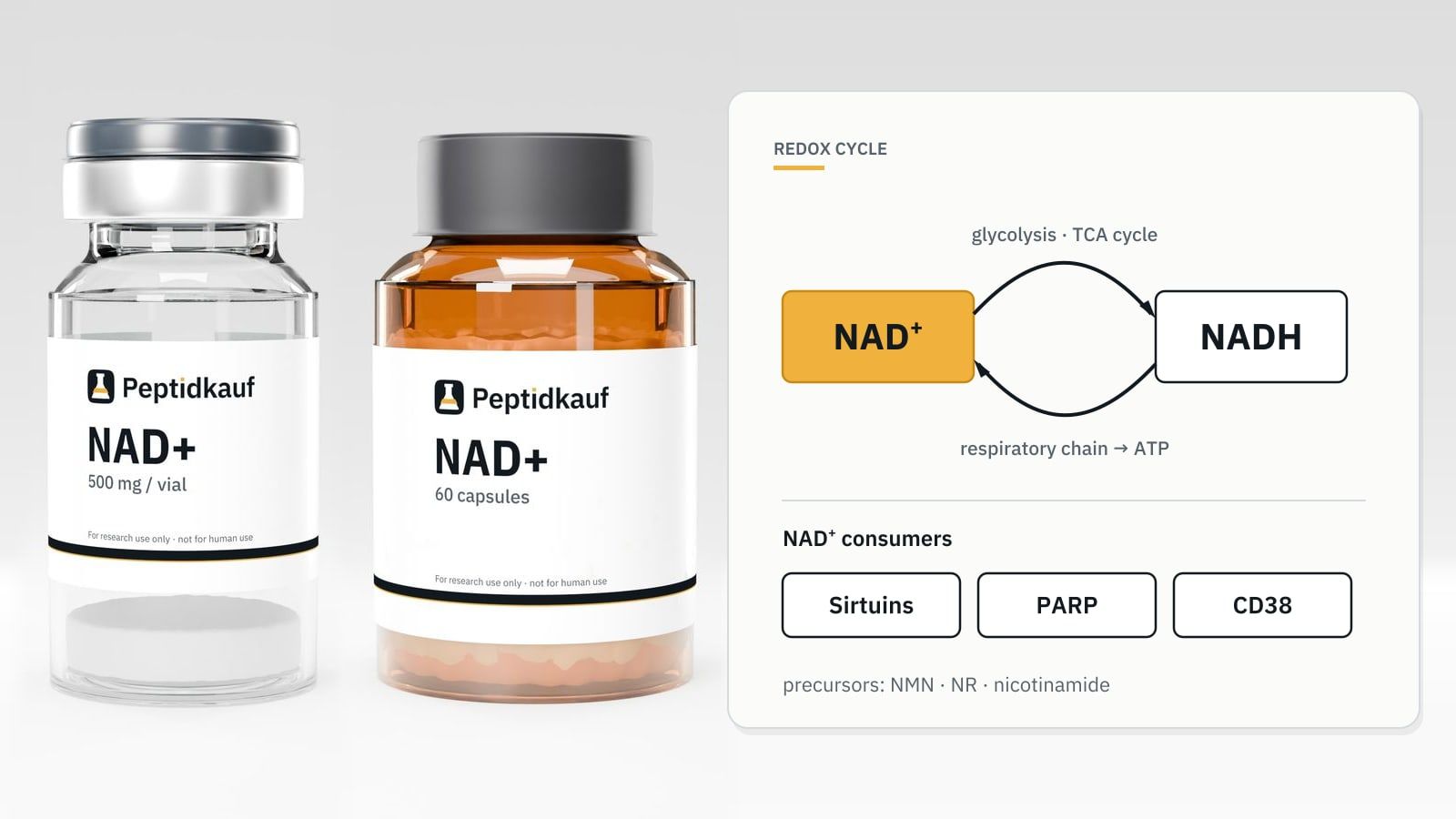
NAD+ and NADH form a pair. While nutrients are broken down, NAD+ takes up electrons and becomes NADH. NADH passes these electrons to the mitochondrial respiratory chain, where they help make ATP, the cell's energy carrier. This regenerates NAD+.
| Form | State | Main role |
|---|---|---|
| NAD+ | oxidised | Accepts electrons; substrate for sirtuins, PARP and CD38 |
| NADH | reduced | Delivers electrons to the respiratory chain |
The ratio of NAD+ to NADH indicates the energy status of a cell. Anyone searching for "NADH effects" is looking at the same substance in another state. In the body the two forms constantly convert into each other.
What NAD+ does in the cell
Energy metabolism
Without NAD+, neither the breakdown of sugar (glycolysis) nor the citric acid cycle nor fatty acid oxidation can run. This role does not consume NAD+; it only recycles it.
Sirtuins
Sirtuins are enzymes that chemically modify other proteins and so regulate genes and metabolic pathways. In doing so they cleave NAD+. Because sirtuins have been linked to stress resistance and lifespan in model organisms, NAD+ features prominently in ageing research.
DNA repair by PARP
PARP enzymes detect DNA damage and start the repair. They also consume NAD+, in large amounts when damage is severe.
CD38
The enzyme CD38 on immune cells breaks down NAD+. Its activity increases with age and inflammation in animal models and is considered one reason for falling NAD+ levels.
Does NAD+ decline with age?
In mice and rats the NAD+ content of many tissues falls with age, for example in muscle, liver and brain. In humans the data are less consistent: some studies found lower levels in the skin, muscle or brain of older people, others hardly any difference. Measurement is difficult because NAD+ is fragile and results vary by tissue and method.
What do studies on NAD+ precursors show?
In animal models NMN and NR improved many readouts: insulin sensitivity, mitochondrial function, endurance and vascular function. These findings started the hype.
In humans the picture is more sober. Several controlled trials show that NR and NMN reliably raise NAD+ in blood. Clinical effects, however, were small or absent; individual trials reported slight improvements, for instance in muscle insulin sensitivity in certain groups, others found no change. There are no large long-term trials on hard endpoints such as disease or lifespan.
NMN, NR or NAD+?
NMN and NR are precursors from which the cell makes NAD+ in one or two steps. NAD+ itself is a larger, charged molecule that hardly enters cells intact; NAD+ supplied from outside is largely broken down into smaller building blocks in the body and rebuilt inside the cell. For cell experiments that measure NAD+-dependent enzymes directly, pure NAD+ is nevertheless the standard reagent. Whether NAD+ capsules deliver intact NAD+ is therefore itself a research question.
NAD+ infusions
NAD+ infusions are offered in private clinics. They have hardly been studied scientifically: there are only small studies, mainly showing how NAD+ is metabolised in blood. Evidence of a health benefit is lacking.
Side effects and safety
In the NR and NMN trials the substances were well tolerated over weeks to months; occasional mild gastrointestinal complaints were reported. With niacin (nicotinic acid), another precursor, skin flushing is typical. In small NAD+ infusion studies, transient nausea, chest pressure and discomfort occurred. Long-term data are missing for all forms. It is also debated whether a permanently raised NAD+ level could favour unwanted cells such as cancer cells; robust data on this do not exist.
NAD+ in the lab
In cell and enzyme experiments NAD+ is used as a pure reagent, for example to measure sirtuin or PARP activity. NAD+ is sensitive to moisture, light and heat; in solution it decomposes faster, especially at alkaline pH. Stored dry, cool and dark, the lyophilisate stays stable for a long time. Peptidkauf offers NAD+ as a research reagent with a lab report for every batch.
Frequently asked questions about NAD+
What does NAD+ do in the body?
NAD+ carries electrons in energy metabolism and is a substrate for enzymes such as sirtuins and PARP, which take part in gene regulation and DNA repair.
What is the difference between NAD+ and NADH?
NAD+ is the oxidised form, NADH the reduced form. The two constantly convert into each other in the cell.
Can NAD+ levels be raised?
Precursors such as NR and NMN raise NAD+ levels in blood in trials. Whether that brings a health benefit has not been shown.
Does NAD+ have side effects?
Precursors were mostly well tolerated in trials. Infusions caused transient complaints such as nausea. Long-term data are missing.
Is NAD+ a peptide?
No. NAD+ is a coenzyme made of two nucleotides. It is, however, often studied alongside peptides such as MOTS-c or SS-31 in mitochondrial research.
Conclusion
What NAD+ does in the cell is well understood: it is indispensable for energy metabolism, sirtuins and DNA repair. That its level falls with age is well documented in animals, less clearly in humans. Precursors raise the level reliably, but a clinical benefit has not been demonstrated. For research NAD+ remains a central molecule; health promises lack a foundation.