Lyophilised peptides: freeze-drying, storage and shelf life
Peptidkauf Redaktion2 min read
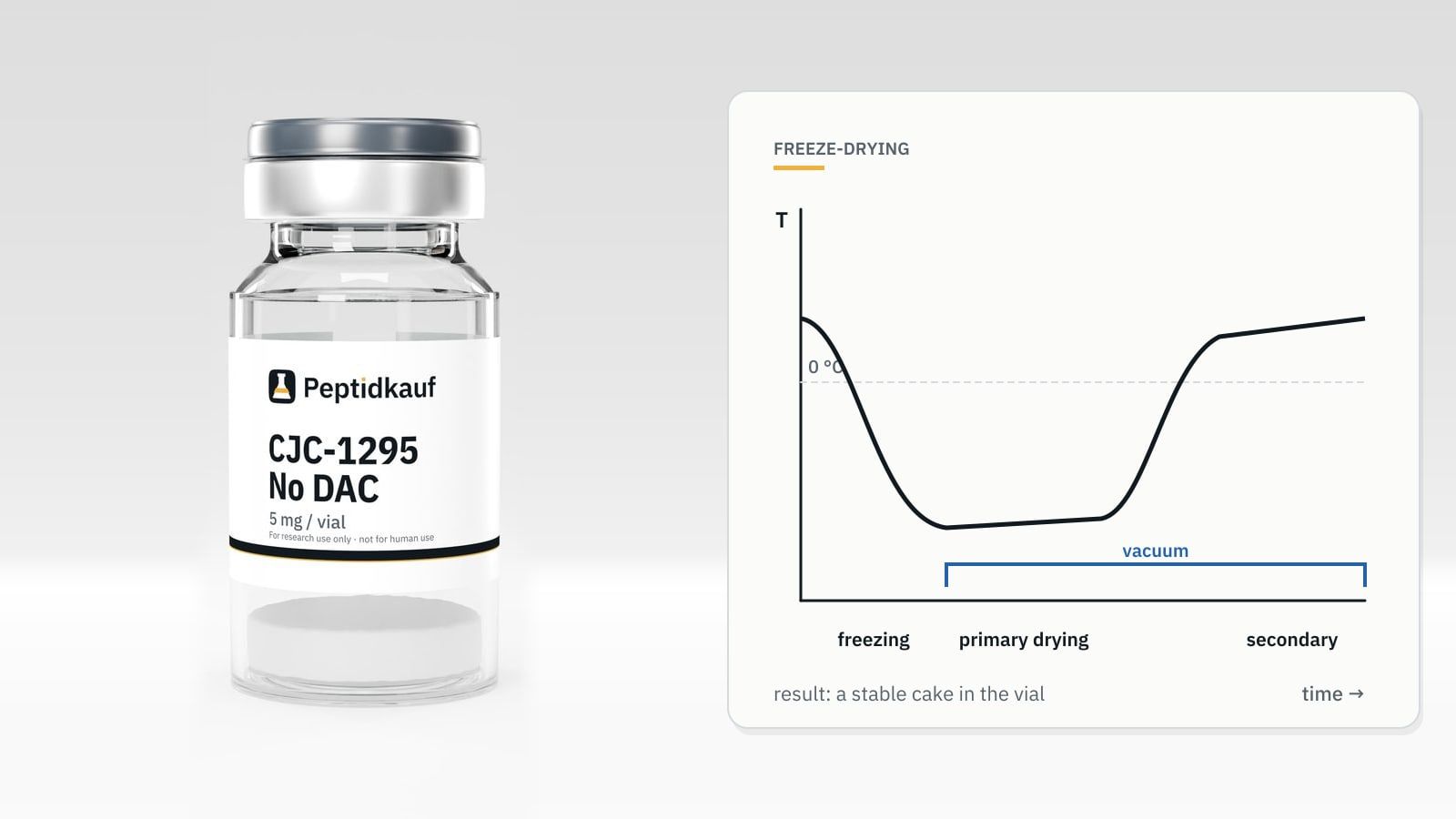
Almost every research peptide arrives as a white, fluffy powder in a sealed vial. This lyophilisate is the result of an elaborate drying process that makes peptides storable and shippable in the first place. This article explains what happens during freeze-drying, what the powder in the vial reveals and the storage rules that apply in the lab.
At a glance
- Water drives almost every degradation reaction of peptides; without it they stay stable for a long time.
- Freeze-drying removes water without heating: ice turns directly into vapour under vacuum.
- Dry, cold and dark, a lyophilisate keeps for months to years; dissolved, only days to weeks.
- The amount on the label is the powder mass, not necessarily the amount of pure peptide.
Why water is the problem
In solution, typical degradation pathways are hydrolysis of the chain, deamidation of asparagine and glutamine and oxidation of sulphur-containing residues such as methionine and cysteine. All run much faster in water; remove the water and they almost stop.
How freeze-drying works
| Step | What happens | What matters |
|---|---|---|
| Freezing | The peptide solution is frozen completely in the vial | Even ice crystals for an even structure |
| Primary drying | Under vacuum the ice sublimes, heated shelves supply the energy | The product must not warm enough to collapse |
| Secondary drying | Gentle warming releases bound residual water | Sets the residual moisture and so the shelf life |
Vials are usually closed inside the chamber, often under nitrogen, so no moist air gets in.
What the cake tells you
An even, white, fluffy cake indicates a well-run process. A collapsed, shrunken or discoloured cake can point to drying problems or moisture. After shipping the cake is often broken into loose powder, which is purely mechanical and harmless.
Storage rules in the lab
| State | Storage | Note |
|---|---|---|
| Lyophilisate, unopened | −20 °C, dry and dark | Briefly stable at room temperature, e.g. in transit |
| Before opening | Let the vial reach room temperature | Prevents condensation on the powder |
| Dissolved peptide | 2–8 °C, days to weeks | Freeze aliquots for longer storage |
| Frozen solution | Avoid repeated thawing | Each cycle can damage the peptide |
Label amount and actual content
A lyophilisate also contains counter-ions from manufacturing and some residual water, so '10 mg' usually describes the powder. The lab report shows the measured peptide amount; use that for accurate concentrations. See peptide purity: reading a lab report.
From powder to solution
Dissolve with bacteriostatic water or sterile water, slowly down the glass wall, without shaking. Technique: reconstitution in vitro; amounts: peptide calculator.
Conclusion
Freeze-drying is why research peptides can be shipped and stored at all. Dry, cold, dark, fresh solutions and no repeated thawing keep the material's quality from arrival to experiment.