What does KPV do? The α-MSH tripeptide in research
Peptidkauf Redaktion4 min read
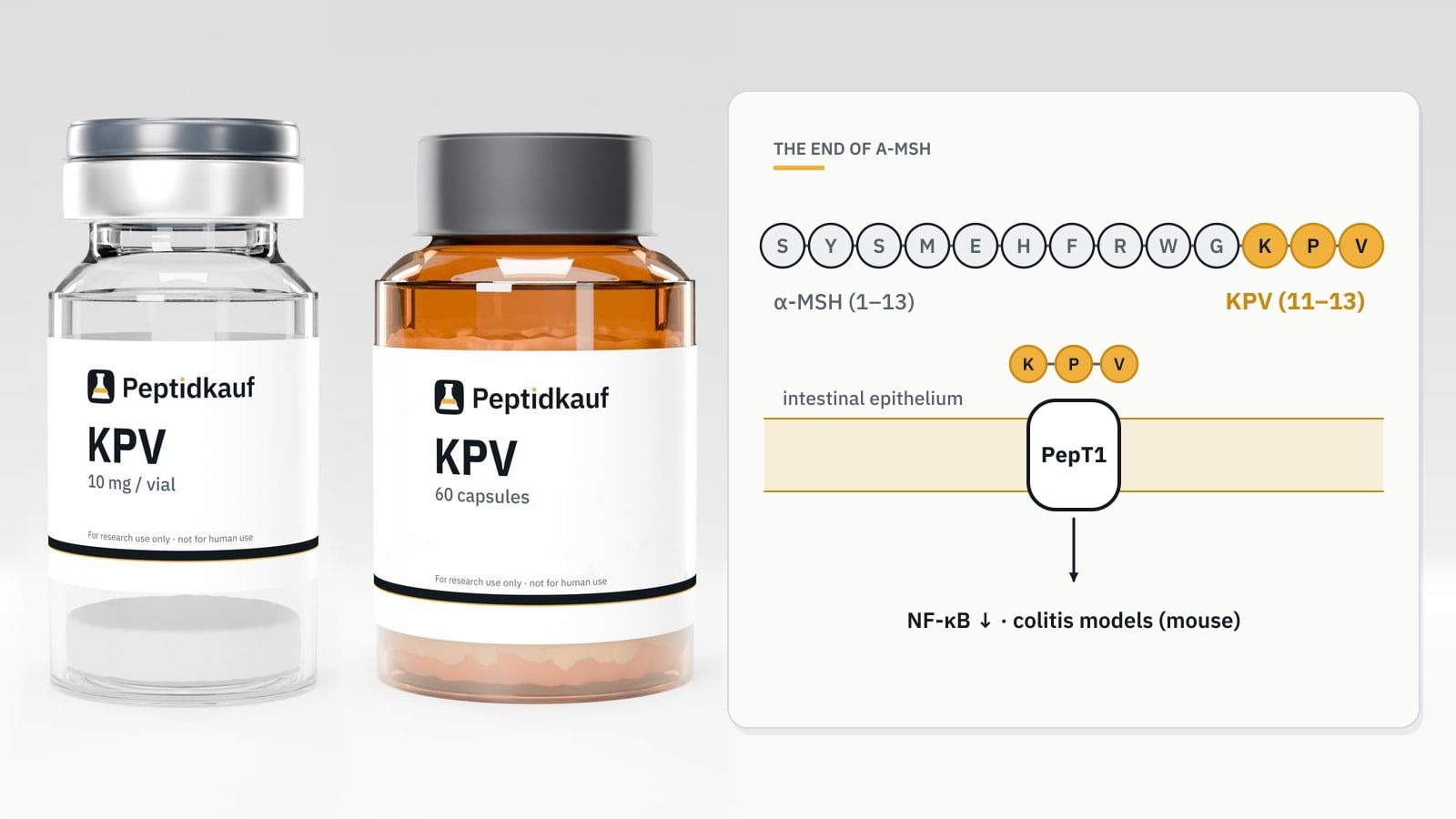
KPV is one of the smallest peptides with a research role of its own: three amino acids, lysine, proline and valine. It is the tail end of the hormone α-MSH and keeps its anti-inflammatory properties without tanning the skin. KPV is especially interesting because the gut takes it up through a dedicated transporter, which is rare for a peptide. This article answers what KPV does in models, how it works and which questions remain open. It describes research and contains no usage or dosing advice.
At a glance
- KPV (Lys-Pro-Val) corresponds to amino acids 11–13 of the hormone α-MSH.
- In cell and animal models it dampens inflammation, mainly via the NF-κB pathway.
- The gut transporter PepT1 carries KPV into intestinal cells; in mouse colitis models it worked when given in drinking water.
- There are no human studies; KPV is not approved as a medicine.
What is KPV?
α-MSH is a 13-amino-acid hormone that stimulates pigmentation and dampens inflammation through melanocortin receptors. As early as the 1980s and 1990s it became clear that much of the anti-inflammatory activity sits in the tail: the last three amino acids, Lys-Pro-Val. This tripeptide, KPV, hardly affects pigmentation in models but keeps the anti-inflammatory effects.
The related peptides that mimic the whole hormone are covered in melanotan 2, melanotan 1 and PT-141.
What does KPV do? The mechanism
How KPV works is not fully resolved. Two routes are discussed:
- Through receptors: part of the effect may, as with α-MSH, run through melanocortin receptors, mainly MC1R and MC3R on immune cells.
- Inside the cell: other work shows that KPV enters cells and prevents the inflammatory switch NF-κB from moving into the nucleus. As a result, fewer inflammatory signals such as IL-6, IL-8 and TNF-α are made.
The role of PepT1
The second route explains what makes KPV special. Intestinal cells carry the transporter PepT1, which takes up small peptides from food, and it also recognises KPV. In gut inflammation, PepT1 is even upregulated in the colon. A widely cited paper (Dalmasso et al., Gastroenterology 2008) showed that KPV enters intestinal cells this way and that KPV in drinking water reduced inflammation in mouse colitis models.
What do the studies show?
| Model | Finding | Evidence |
|---|---|---|
| Colitis (mouse) | Less inflammation, weight loss and tissue damage | Animal models, several papers |
| KPV in nanoparticles | Targeted release in the colon, effect at low amounts | Animal models |
| Skin, wounds | Less inflammation in dermatitis and wound healing models | Cell and animal models |
| Microbes | Inhibition of Staphylococcus aureus and Candida albicans in the lab | Cell culture |
| Humans | No controlled studies | Missing |
The findings are consistent but come from a limited number of groups and exclusively from laboratory and animal models.
KPV and BPC-157
KPV is often mentioned together with BPC-157 because both were studied in gut models. The approaches differ: BPC-157 is mainly linked to angiogenesis and tissue repair, KPV to the inhibition of inflammatory signals. There are no studies of the combination. For experiments with both there is the blend BPC-157 + KPV; KPV is also part of KLOW, covered in GLOW and KLOW.
Open questions
- How much of the effect comes from receptors and how much from the route into the cell?
- How stable is KPV in the human digestive tract, and how much reaches the colon?
- Do the findings from mouse models translate to humans?
KPV in the lab
As a tripeptide KPV is readily soluble and stable. Because it is so small, identity and purity matter especially: small impurities from similar tripeptides barely show in the mass but do show in HPLC. Peptidkauf offers KPV as lyophilised powder and as KPV capsules for release and uptake experiments, each with a lab report for every batch.
Frequently asked questions
What does KPV do?
In cell and animal models KPV dampens inflammation, mainly by inhibiting the NF-κB pathway. Human studies are lacking.
Where does KPV come from?
KPV is the tail end (amino acids 11–13) of the body's own hormone α-MSH.
Does KPV tan the skin?
In studies KPV hardly affected pigmentation, unlike α-MSH or melanotan.
Can KPV be absorbed through the gut?
In mouse models, yes: the transporter PepT1 takes KPV into intestinal cells. This has not been studied in humans.
Conclusion
KPV shows that much of a hormone's effect can sit in a few amino acids. In gut and skin models it dampens inflammation, and the PepT1 route makes it a rare example of an orally studied peptide. Whether this translates to humans is open.