Buying peptides: what to check before you order research peptides
Peptidkauf Redaktion5 min read
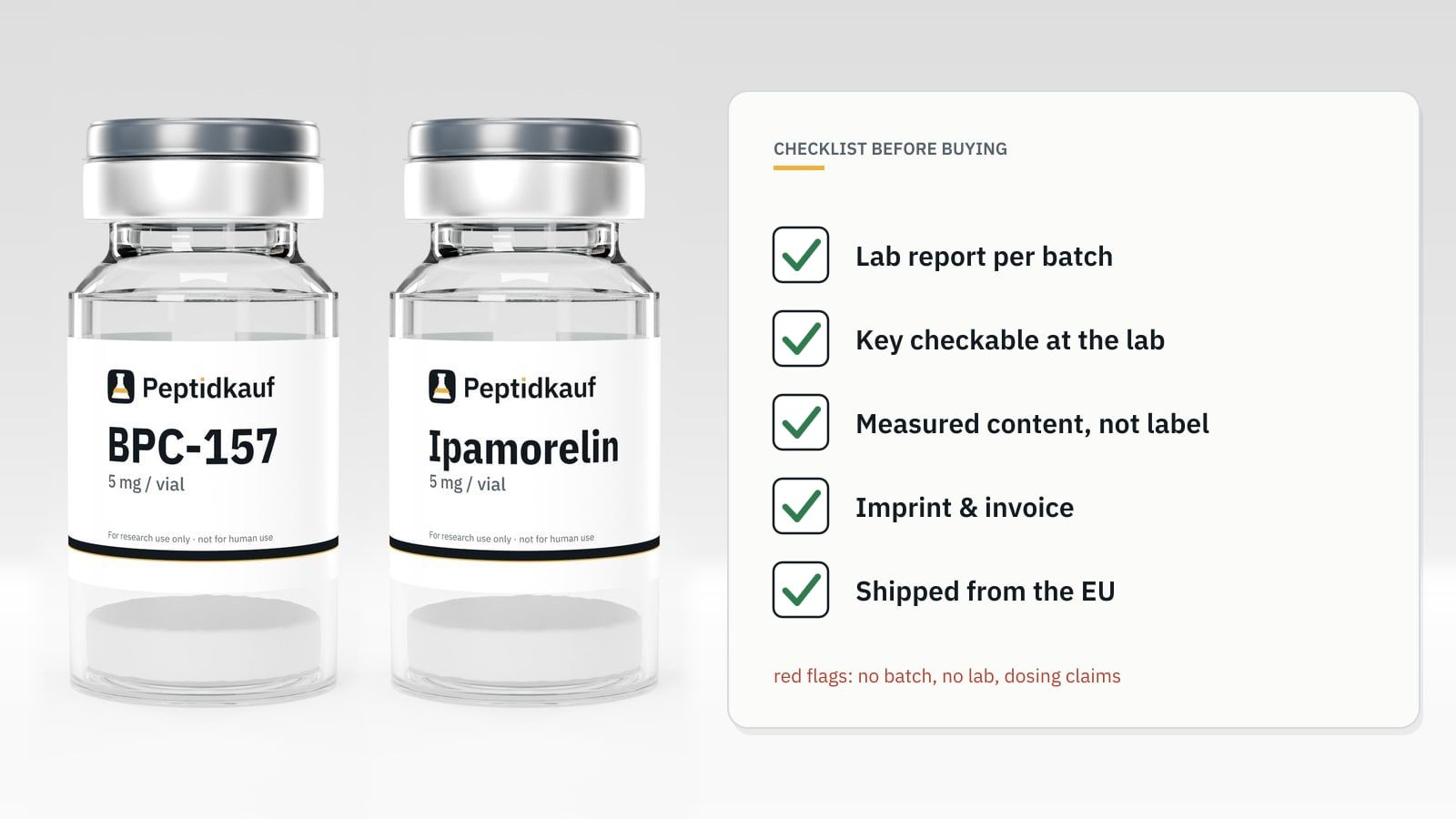
Anyone who wants to buy peptides for laboratory work finds hundreds of shops with almost identical promises: "99 % purity", "lab grade", "fast shipping". Whether that is true is hard to tell from the outside, and that is exactly where problems start. Mislabelled substances, certificates without a batch reference and parcels stuck in customs are not unusual. This guide shows in eight points what to check when buying research peptides, how to verify a lab report in a few minutes and which red flags to take seriously.
At a glance
- What counts is an independent lab report for exactly the batch you receive, not a sample certificate.
- A reputable supplier shows the report before you buy and lets you verify it directly with the laboratory.
- Shipping from within the EU avoids customs and import problems; an invoice showing VAT is a good sign.
- Research peptides are laboratory reagents. Avoid suppliers that advertise dosages or use in humans.
1. A lab report for every batch, not for the product
Peptides are made in batches, and every batch can turn out differently. A certificate (COA, certificate of analysis) therefore only says something about the batch that was actually measured. Check:
- Does the report carry a batch number?
- Is the same number on the vial you receive?
- Does the analysis date fit the batch?
Many shops show a single certificate per product, sometimes years old. That is no proof of what you are buying. At Peptidkauf the report of the current batch is shown on the product page for every size; all reports are in the lab report archive.
2. Independent laboratory and verifiable report
A report produced by the manufacturer itself says less than one from an independent laboratory. Better still is a report that can be verified at the laboratory, for example with a verification key or order number. That rules out a PDF being altered afterwards. Make sure the laboratory is named and the report describes a test method.
3. HPLC for purity, mass spectrometry for identity
Two measurements belong together:
| Method | What it shows | What it does not show |
|---|---|---|
| HPLC | How pure the sample is chromatographically (share of the main peak) | Which molecule the main peak is |
| Mass spectrometry (MS) | Whether the mass matches the expected peptide | How much impurity is present |
| Content assay | How much peptide is actually in the vial | Purity |
High HPLC purity alone does not prove that the right peptide is in the vial. For substances that are often confused, such as retatrutide, tirzepatide and semaglutide, identity testing is decisive. How to read a report in detail is explained in peptide purity: HPLC, MS and the COA.
4. Measured content, not the label
If the vial says "10 mg", the report should show how much was actually measured. Shortfalls are a common problem with cheap offers. For accurate laboratory concentrations, calculate with the measured amount; the peptide calculator helps.
5. Shipping from the EU, invoice and imprint
Buying from a supplier within the EU is the safe choice for buyers in Germany, Austria and the rest of the Union: no customs duty is charged and parcels are not held at import. Shipments from third countries can be inspected and detained by customs, especially when they look like medicines.
You can also recognise reputable suppliers by:
- a complete imprint with company name, address and registration number,
- an invoice showing VAT,
- customer service reachable by email,
- transparent shipping costs and delivery times.
6. Storage in transit and after delivery
Freeze-dried peptides are fairly stable when dry and tolerate shipping at room temperature for a few days. After arrival they belong somewhere cool, dry and dark, many lyophilisates ideally in the freezer. Peptides in solution are much more sensitive. More in lyophilised peptides: stability in the lab.
7. Clear classification as a research reagent
Research peptides are laboratory reagents, not medicines, supplements or cosmetics. A reputable supplier describes identity, purity and laboratory handling, but no dosages and no use in humans. This is more than a formality: selling peptides with usage instructions moves them legally towards unapproved medicines. The legal background is explained in are peptides legal? and on the legal status page.
8. Payment and price
Look for traceable payment methods such as SEPA bank transfer. A very low price is rarely a bargain with peptides: synthesis, purification and an independent analysis of every batch cost money. Compare prices per milligram, taking the measured content into account.
Red flags at a glance
- Certificates without a batch number, or with the same date for every product
- No way to verify the report with the laboratory
- Dosing information, "cycles" or before-and-after promises
- No imprint, or only a contact form
- Cryptocurrency as the only payment method, with no invoice
- Shipping from third countries with no information on customs clearance
A single red flag proves nothing. If several come together, buy elsewhere.
Buying research peptides: frequently asked questions
Can peptides be bought legally in the EU?
Research peptides offered and sold as laboratory reagents are not medicines. Specific rules can still apply to certain substances, for example under anti-doping law. Responsibility for the actual use lies with the buyer.
How do I recognise a genuine lab certificate?
By a batch number that matches the vial, the name of an independent laboratory, an analysis date and ideally a verification key that lets you check the report with the laboratory.
Why are some peptides so cheap?
Often the analysis is skipped, or the measured content is below the amount on the label. Compare prices per milligram of measured substance.
Is customs duty charged when buying within the EU?
No. Within the EU single market no customs duty applies; the VAT of the destination country is included in the price.
Which peptides are most studied in research?
Among the most searched are BPC-157, GHK-Cu, TB-500 and retatrutide. The whole range is under buy research peptides.
Conclusion
When buying research peptides, documentation counts for more than advertising: an independent, verifiable lab report for exactly your batch, an identity test, shipping from the EU and a clear classification as a laboratory reagent. Checking these points rules out most problems before they arise.