Thymosin alpha 1: effects, studies and approval status
Peptidkauf Redaktion4 min read
Thymosin alpha 1 is one of the few research peptides that is actually used as a medicine, just not in the EU. It is approved as thymalfasin in more than 30 countries, mainly for chronic hepatitis and to support the immune system. At the same time its name is often confused with thymosin beta-4 (TB-500) or thymalin, which are something else entirely. This article explains what thymosin alpha 1 is, how it acts on the immune system and what the studies show. It describes research and contains no usage or dosing advice.
At a glance
- Thymosin alpha 1 is a 28-amino-acid peptide originally isolated from the thymus.
- It activates dendritic cells through Toll-like receptors and influences T-cell maturation.
- As thymalfasin (Zadaxin) it is approved in more than 30 countries, but not in the EU or the US.
- A large sepsis trial published in 2025 found no difference in mortality.
What is thymosin alpha 1?
The thymus behind the breastbone is where T cells mature. In the 1960s and 1970s Allan Goldstein's group isolated a mixture of peptides from thymus extracts, "thymosin fraction 5". In 1977 thymosin alpha 1 was purified and sequenced from it as the first single peptide.
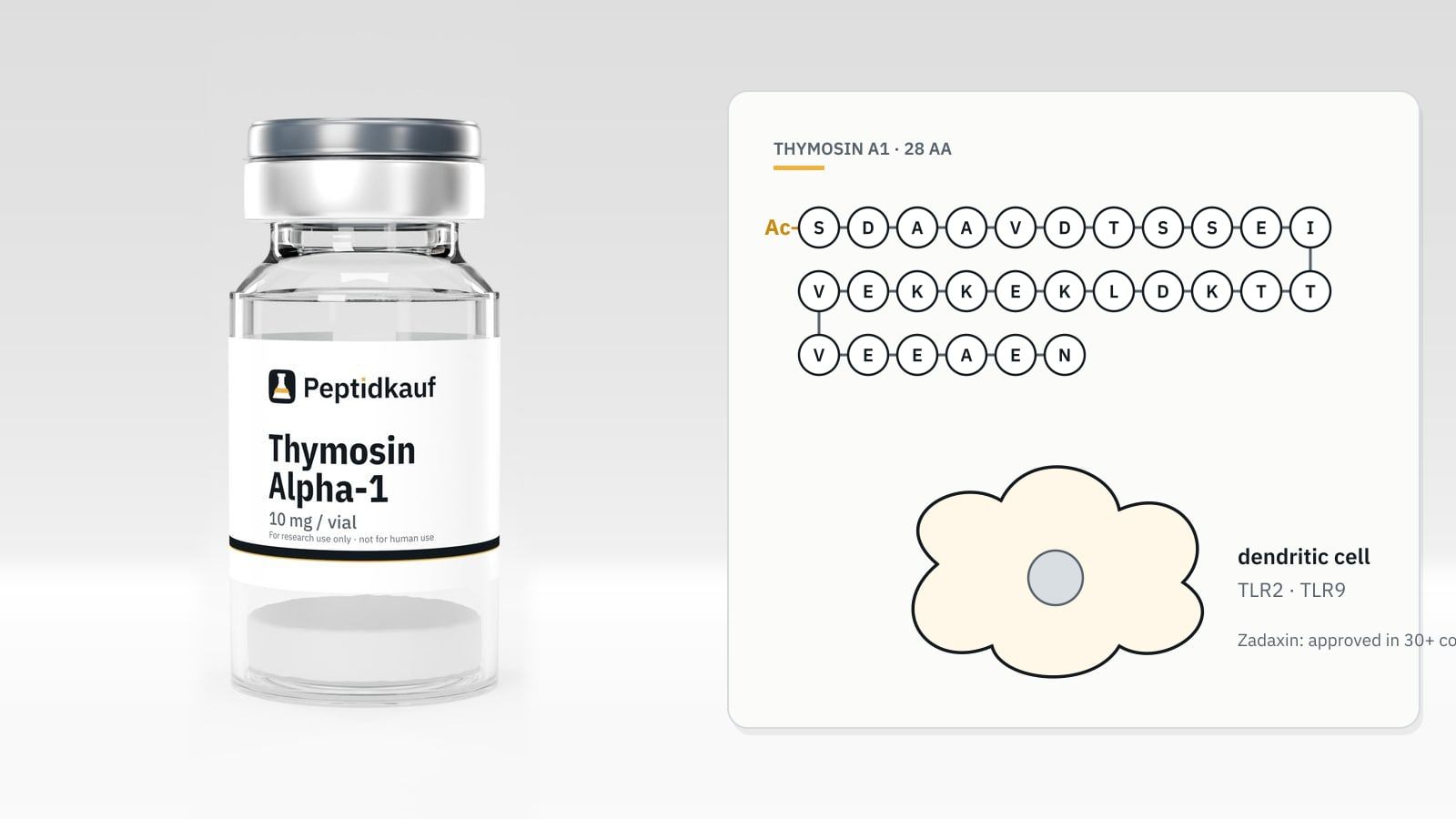
Thymosin alpha 1 consists of 28 amino acids and carries an acetyl group at the start. In the body it is formed from the larger protein prothymosin α. Today it is made entirely synthetically.
Not to be confused with
| Name | What it is |
|---|---|
| Thymosin alpha 1 | 28-amino-acid peptide acting on the immune system |
| Thymosin beta-4 (TB-500) | 43-amino-acid peptide that binds actin; wound healing research |
| Thymalin | Peptide mixture or bioregulator from Russian research |
Despite their similar names the three are chemically and biologically different. TB-500 has its own article, TB-500 vs. thymosin beta-4.
How does thymosin alpha 1 work?
Thymosin alpha 1 acts as a signal for both innate and adaptive immunity:
- Dendritic cells: it binds Toll-like receptors (TLR2 and TLR9) on these sentinel cells and promotes their maturation. Mature dendritic cells present antigens more effectively.
- T cells: in models it promotes T-cell maturation and shifts the response towards Th1 immunity, which matters against viruses and tumour cells.
- Signalling molecules: it changes the production of cytokines such as interferon-γ and interleukin-2.
The peptide therefore does not act directly against pathogens but modulates the immune response. That is why it is mostly studied as an add-on to other treatments.
What do the studies show?
Hepatitis B and C
Most clinical data come from trials in chronic hepatitis B and C, often combined with interferon. Some trials and meta-analyses reported higher response rates than the comparator, but results were not consistent. The approvals in Asia, Latin America and some other countries rest on these data.
Vaccine response
In older people and dialysis patients, whose immune systems respond less to vaccines, thymosin alpha 1 was studied as an enhancer of vaccine response. Some studies found higher antibody titres.
Sepsis
Because sepsis can involve paralysis of the immune system, thymosin alpha 1 was an obvious candidate. A large randomised, placebo-controlled trial from China (TESTS, published 2025), however, found no difference in 28-day mortality.
Cancer and COVID-19
Further studies examined thymosin alpha 1 as an adjunct in cancer and during the COVID-19 pandemic, mostly in China. The data come largely from observational studies and are contradictory; they do not support firm conclusions.
Safety
In clinical trials thymosin alpha 1 was generally well tolerated; mainly local injection-site reactions were reported. Because it stimulates the immune system, it is debated whether it could be unfavourable in autoimmune disease or after organ transplantation. Systematic data are lacking.
Approval status
As thymalfasin (brand name Zadaxin), thymosin alpha 1 is approved in more than 30 countries, including China and several countries in Asia and Latin America. It is not approved as a medicine in the EU or the US. Outside those countries it is only available as a research reagent.
Thymosin alpha 1 in the lab
In cell experiments thymosin alpha 1 is used to study dendritic cell maturation, TLR signalling and T-cell differentiation. As a lyophilisate the peptide stores well; in solution it should be aliquoted and kept cold. Peptidkauf offers thymosin alpha-1 as a research reagent with a lab report for every batch. Related topics are thymalin and further peptides in the longevity research area.
Frequently asked questions
What is thymosin alpha 1?
A 28-amino-acid peptide from the thymus that influences dendritic cells and T cells.
Is thymosin alpha 1 approved in the EU?
No. As thymalfasin it is approved in more than 30 countries, but not in the EU.
Is thymosin alpha 1 the same as TB-500?
No. TB-500 is thymosin beta-4, a different 43-amino-acid peptide with a different function.
What is thymosin alpha 1 studied for?
Mainly chronic hepatitis, enhancing vaccine response, sepsis and as an adjunct in cancer.
Conclusion
Thymosin alpha 1 is a well-characterised immune peptide with decades of clinical history and approvals in many countries. The evidence is strongest in hepatitis and mixed elsewhere, and a large sepsis trial showed no effect. For research it is a valuable tool for understanding how signals from the thymus steer the immune response.